
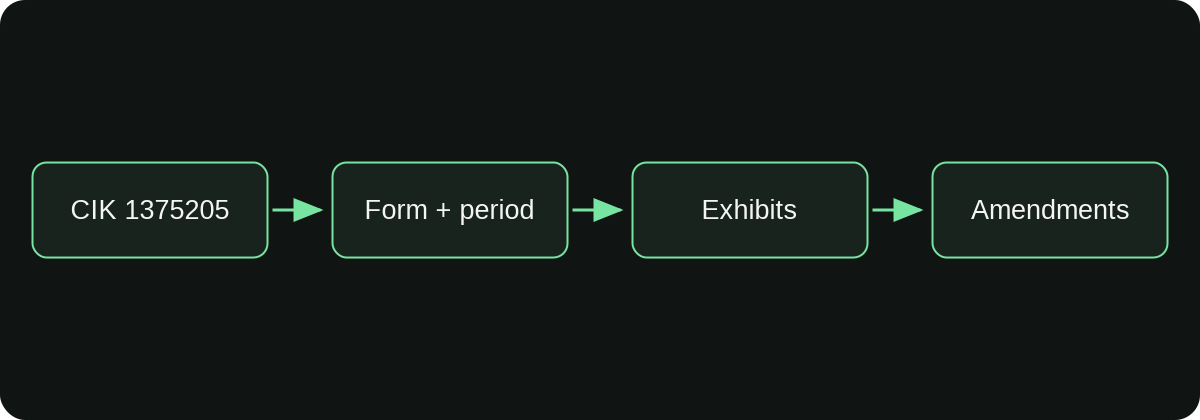
Find URG Stock filings by searching for Ur-Energy’s exact issuer identity, then select the form, reporting period and filing date. The company’s CIK is 1375205. A reliable lookup also checks amendments and exhibits rather than stopping at a third-party earnings summary.
The main task is finding the document that answers your question. Annual statements, quarterly updates and event reports are related records, but they are not interchangeable sources for every claim.
Begin with the issuer rather than only the ticker
Use the company’s SEC filing directory or the SEC’s EDGAR company search. Confirm Ur-Energy Inc. and the identifier before downloading a document.
Tickers can be similar, and search results can include unrelated articles. A company’s Canadian listing can also appear alongside its US symbol. The issuer identity is the stable starting point for the filing record.
Keep an accession number or original document link with your notes. That makes a later reader able to locate the same version. A generic link to a search-results page may change as new filings arrive.
Do not enter broker credentials or wallet information into a filing-search website. Public securities filings can be read without giving a stranger control of an investment account.
Choose the form for the question
A 10-K provides annual reporting and a broad business, risk and financial discussion. A 10-Q updates quarterly financial and operating information. An 8-K reports specified current events and may include useful exhibits.
For example, Ur-Energy’s September 30, 2026 10-Q is a quarterly report. Its filing date and financial period are different fields; preserve both.
A press release attached to an event filing can be helpful, but it does not replace the quarterly statement notes when you need accounting definitions. Conversely, a material event after quarter end may require checking later filings rather than relying only on the quarter’s balance sheet.
The earnings-reading guide explains how to combine the documents after locating them. Navigation and interpretation are separate parts of the research process.
Distinguish filing date from measurement date
A report filed in November can contain financial statements measured at September 30. A technical report can have its own effective date earlier than publication. A later event may be discussed in a subsequent-events section.
Build a small date table with filing date, period end, relevant event date and technical effective date where applicable. That prevents a recent upload from making older measurements look current.
When comparing two periods, use matching definitions and durations. A quarter, nine-month year-to-date result and annual balance should not be mixed without explanation.
For an event-driven question, check the chronology. Information published after a market session cannot automatically explain a price movement earlier in that session. The filing timestamp is part of the evidence.
Follow exhibits when the main report points to them
Mining disclosures can rely on technical reports and other attached materials. The company technical archive helps identify project-specific documents and their dates.
If a filing says a report is incorporated by reference, follow the reference rather than assuming the latest page you find contains every relevant detail. Preserve the project, authoring framework and version.
For financial arrangements, exhibits can contain terms not visible in a short press release. Read the actual agreement where needed, while noting redactions or omitted details. An absence of public detail is not permission to invent a contract term.
For resource questions, use the technical document’s categories and limitations. A promotional slide may summarize the result, but it should not override the report’s classification or effective date.
Check for amendments and later developments
An amended form can revise or supplement a prior filing. Determine what changed and whether the original remains relevant to the historical question. Do not assume every amendment replaces every part of a document.
Similarly, a later quarterly or event filing can update an earlier forecast. Keep the earlier statement for comparison, but do not present it as the current outlook after a disclosed change.
A version log is simple: original link, date checked, amendment link, changed section and effect on your analysis. It is especially useful when reproducing a calculation or a statement made at a particular time.
Avoid changing historical conclusions silently. If new information alters the analysis, identify the substantive update rather than only moving the article’s timestamp forward.
Search within the document using a precise question
Use terms associated with the task: inventory for physical reconciliation, sales agreements for commercial exposure, liquidity for funding, or mineral resources for geological classification. A broad search for uranium can produce too many unrelated hits.
Read the surrounding section and definitions before extracting a sentence. A table heading, unit or footnote can materially change what a number means. Search is a navigation aid, not a replacement for context.
For instance, a cost-per-pound figure may cover produced material rather than all delivered pounds. A cash balance may exclude or include restricted resources. Preserve those labels in your notes.
The cost article demonstrates why matching numerator and denominator matters. The tax article shows why issuer disclosures can raise a separate question even for a US-listed share.
Keep a research record that another reader can follow
Record the claim, source form, section, period, units and calculation if any. Copy the source link and summarize the conclusion in your own words. Avoid building an investment argument from disconnected search snippets.
Before publishing, reopen material links and check whether a newer filing changes the statement. Do not call a historical annual figure current merely because the issuer has not changed its website description.
A compact, traceable file is more useful than a folder full of unlabeled PDFs. It supports later updates and makes disagreements about the evidence easier to resolve.
Filing-navigation questions
Does an SEC-hosted filing mean the SEC endorses the investment?
No. Public filing availability is not a recommendation, valuation guarantee or certification that the shares suit an individual investor. Read the disclosure and assess the relevant risks independently.
Can I use a search snippet if the full filing is accessible?
Use the snippet to locate the document, then check the full passage. Truncation can omit units, dates and qualifications that materially change the meaning of a claim.
What if a company PDF and the SEC HTML view look different?
Compare the filing identifier, content and version. Presentation differences can be harmless, but a different period or amendment is substantive. Establish that you are reading the same document before reconciling figures.