
US investors in URG Stock should review capital-gain records, account type and foreign-corporation disclosures rather than assuming a US listing creates ordinary domestic-stock treatment in every respect. Ur-Energy’s annual report specifically raises possible PFIC status, which requires a separate tax analysis.
This guide organizes the questions and records. It does not determine an individual’s federal, state or cross-border liability or establish the company’s tax classification for every year.
Begin with the taxpayer and account
Identify whether the holding belongs to an individual, retirement arrangement, business or another entity. Account type can change the analysis, so do not apply a taxable brokerage example automatically to every account.
Record tax residence and relevant years. Moving countries or holding the shares through another entity can introduce additional questions. The exchange where an order executes does not alone settle those obligations.
Also identify the exact security and issuer. URG and URE are trading routes for Ur-Energy, not evidence that one version of the company is automatically domestic for US tax purposes.
The dual-listing guide separates venue and currency. Tax classification needs the issuer and investor facts in addition to the ticker.
Keep acquisition and sale records
For ordinary basis analysis, preserve purchase date, quantity, price, charges, account and later adjustments. Retain trade confirmations rather than relying only on a current average-cost display.
On a sale, record the actual filled quantity, proceeds, costs and lot-selection information. Partial fills and multiple acquisitions can make the records more complex than one purchase and one sale.
The IRS capital-gains topic explains the general framework for determining gain or loss on capital assets. Specialized rules can change the result, so treat the basic subtraction as a starting calculation rather than a complete conclusion.
For illustration, a hypothetical $1,000 basis and $1,200 sale proceeds suggest a $200 difference before relevant adjustments and specialized treatment. These are teaching inputs, not a tax result for an actual URG position.
Review the company’s PFIC disclosure separately
Ur-Energy’s 2025 annual report says it may be a passive foreign investment company for 2025 and subsequent years. “May be” should not be rewritten as a definitive determination for every holding period.
The disclosure matters because PFIC rules can change reporting and the treatment of distributions or sale gains. A US exchange listing does not remove the issue. Nor does the company operating mines in the United States automatically resolve the parent corporation’s classification.
Review the relevant tax year and your own holding history. The applicable consequences can depend on elections and prior years, so a current-year snapshot alone may not answer the question.
For a US investor, this is a reason to obtain qualified tax advice before an election deadline or filing decision, not to choose a form or classification solely from a general stock article.
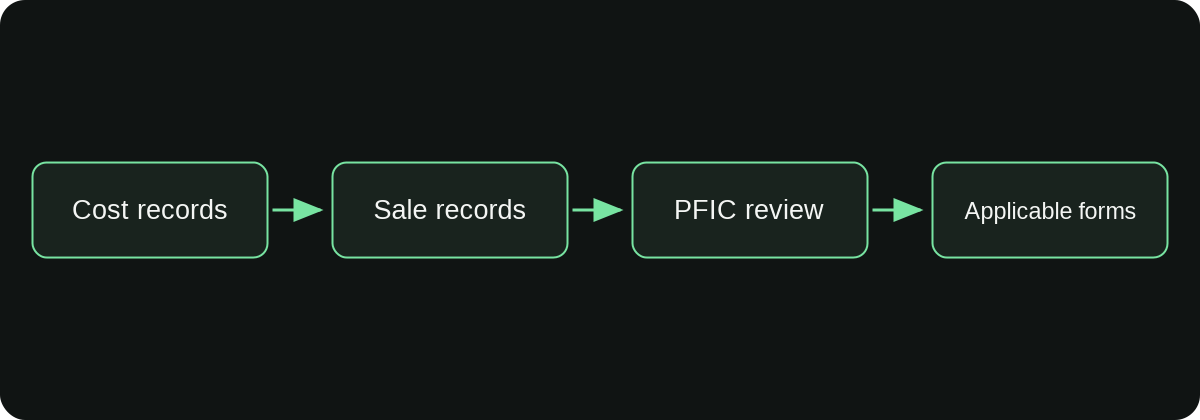
Understand that Form 8621 is not a generic stock-sale form
The IRS Form 8621 instructions describe reporting involving PFICs and related elections. They contain conditions and exceptions that should be applied to the actual facts.
A qualified electing fund election and mark-to-market treatment are not interchangeable defaults. They can require eligibility, timely action and specific information. Do not select one because another investor used it.
Likewise, an exception from one reporting requirement does not automatically eliminate every substantive tax consequence. Distinguish filing obligations from how income or gain is calculated.
Keep any issuer-provided annual information statement with the tax records and verify the year it covers. A document for an earlier year should not silently support a later-year election or calculation.
Do not assume broker reporting is complete tax advice
A broker statement can provide proceeds and basis information under its reporting framework. It may not resolve every foreign-corporation issue, election or investor-specific adjustment.
Reconcile statements with original trades, corporate actions and any relevant transfer records. A missing basis can reflect incomplete information rather than a genuine zero-cost acquisition.
If you transfer between brokers, confirm that the history follows accurately. Keep your own records so the eventual return does not depend entirely on one provider’s current interface.
The selling workflow explains the operational record from order to settlement. Tax recognition and filing duties should be assessed under the relevant rules rather than equated automatically with a later bank withdrawal.
Treat dividends, distributions and currency as separate questions
The company’s disclosed dividend policy is addressed in the dividend article. A current absence of regular dividends does not mean a sale can never create a taxable event.
If a future distribution occurs, preserve its classification, amount, currency and withholding information. Do not assume every payment receives identical treatment merely because the broker labels it a dividend.
For a Canadian-dollar trading route, retain the exchange-rate information needed to calculate US-dollar values under applicable rules. A gain measured in Canadian dollars can differ from the US-dollar result.
Foreign tax credits, treaty questions and account-specific treatment require their own factual review where relevant. Avoid applying a standard withholding rate without establishing the issuer, payment and investor conditions.
Prepare a tax-review file before filing season
Keep a chronological list of acquisitions, sales, transfers, corporate actions and distributions. Add the company’s relevant tax disclosure and any annual information supplied for your holding.
Identify open questions early: possible PFIC classification, election history, missing basis, currency conversion and account treatment. An adviser can work more efficiently with a complete record than with an isolated year-end balance.
Do not treat a profitable investment decision and a compliant return as the same task. Accurate reporting depends on records and the correct rules, even when the dollar amount or share-price movement seems small.
US tax questions
Does buying URG instead of URE automatically remove PFIC considerations?
No. A trading symbol or quotation currency does not by itself change the underlying foreign-corporation analysis. Review the issuer, relevant year and your circumstances rather than using exchange location as the answer.
Can an old election affect a later sale?
Potentially. Election timing and holding history can matter under specialized rules. Preserve prior returns and elections and obtain advice before assuming the current broker statement contains the complete answer.
Should I copy another shareholder’s Form 8621 approach?
No. Eligibility, account facts, holding dates and elections can differ. Use the official instructions and individualized professional advice for a decision that can affect several tax years.