
URG Stock and URE are Ur-Energy’s US and Canadian exchange listings. They provide exposure to the same issuer through different trading routes, with different quote currencies, liquidity and broker conditions. A price difference on screen does not automatically create a risk-free arbitrage.
Begin by comparing the security identity and account support, then normalize currency and timing. The underlying company can be the same while the practical cost of obtaining or selling exposure differs.
Verify both listings through the issuer
Ur-Energy maintains pages for NYSE American URG and TSX URE. Confirm the listing and currency rather than relying on a search abbreviation.
URG is the US-dollar trading route and URE is the Canadian-dollar route. That is a quotation distinction, not evidence that one company operates in two separate ways depending on which ticker you buy.
Also distinguish listed shares from a derivative or another product referencing the issuer. The broker’s instrument description matters. A similarly named contract is not automatically the same security as the exchange-listed common share.
For the company itself, use one set of operating filings and project evidence. Do not count the two listings as two separate mining businesses or double the company’s resources because it appears on two exchanges.
Convert the currency before comparing prices
Use a contemporaneous foreign-exchange rate and comparable market observations. If the rate is expressed as Canadian dollars per US dollar, divide a Canadian-dollar share price by that rate to obtain a US-dollar equivalent.
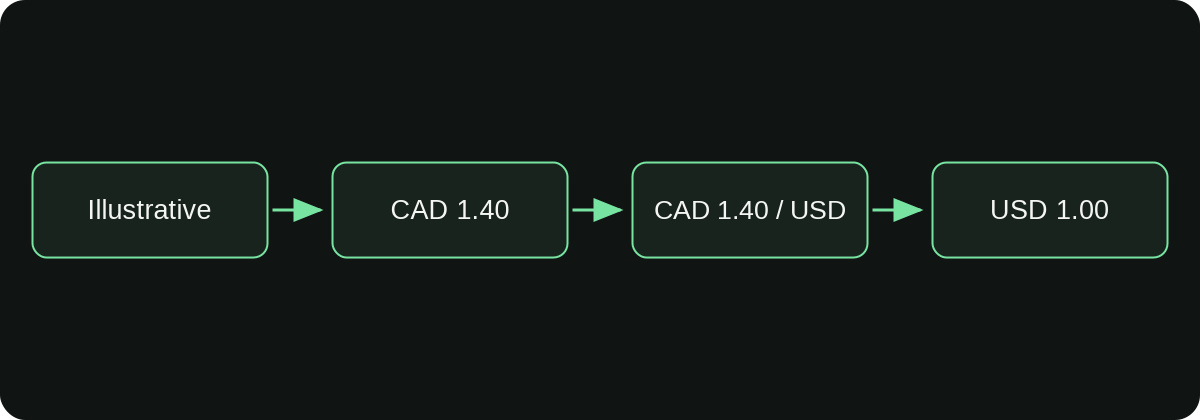
For illustration, a hypothetical C$1.40 quote at C$1.40 per US$1 equals US$1 before costs. That does not establish an executable cross-market trade or describe a current Ur-Energy price.
Use bid and ask appropriate to the action. Buying on one market and selling on another involves different sides of the spread. A comparison of two last trades can exaggerate an apparent opportunity.
Distinguish a general foreign-exchange reference from the conversion rate your broker will actually apply. The usable rate can include its own spread and account-specific conditions.
Include conversion charges, commissions and transfer costs where relevant. A small nominal difference can disappear after these costs, and the prices can move while you arrange the transaction.
Match timestamps and market sessions
One quote may be delayed while another updates more frequently. Ur-Energy’s quote pages identify data-provider timing conditions, so preserve the delay notice and observation time.
A US holiday can also leave the US listing without a new regular-session trade while the Canadian market follows its own calendar. Do not interpret the resulting timestamp mismatch as a fundamental disagreement about the company.
The NYSE calendar identifies US holidays and shortened sessions. Check the relevant Canadian exchange schedule separately for the actual date rather than assuming the calendars always match.
If comparing performance, use aligned dates and a consistent currency basis. A currency movement can change a foreign-currency return even when the local quote is unchanged.
Ask the broker about holding and transfer mechanics
Do not assume a position can be journaled or transferred between listings instantly or without cost. Eligibility, settlement, custody arrangements and account policies determine what the broker supports.
Ask which exact security identifier is held, whether a cross-market transfer is possible, how long it takes and whether trading is restricted during the process. Obtain the terms before planning an apparent arbitrage.
A transfer can expose you to price and currency changes while it is pending. The ability to sell one route does not prove the other route is available in the same account at the same moment.
For a simple investment, avoiding unnecessary transfers can reduce operational complexity. Compare the route that already fits your funding currency and account access with any alternative’s complete cost.
Separate quote currency from business currency exposure
Buying a Canadian-dollar quote does not turn the underlying operating business into a pure Canadian-dollar asset. The company’s revenues, costs, financing and reporting arrangements determine its economic currency exposure.
Likewise, buying URG through a US broker does not by itself determine the issuer’s legal domicile or your tax treatment. Listing venue, corporate identity and investor residence are separate fields.
The US tax article explains why a US listing does not eliminate the need to review foreign-corporation disclosures. Consult the rules relevant to your own account and residence rather than treating the ticker as a tax classification.
Keep acquisition and sale currency records so returns can be measured correctly. A gain in one quotation currency may differ from the result in your reporting currency after conversion and costs.
Choose the route based on the complete task
For a purchase, compare access, currency funding, spread, order support and costs for the intended size. For a sale, compare actual executable bids and the path to usable cash. A route with a superficially attractive quote may not fit the account.
If you already hold shares, include the cost and delay of changing routes. A small improvement in a displayed spread may not justify a transfer whose timing is uncertain.
The buying workflow covers security verification and fills. The selling workflow follows an exit through settlement and withdrawal.
Treat the listing choice as an implementation decision layered on top of the business thesis. It can affect your realized costs without changing the geology, contracts or operating performance that drive the issuer’s value.
Dual-listing questions
Does holding both tickers diversify company risk?
Not in the way holding unrelated businesses would. Both routes expose you to the same issuer. Currency and trading mechanics can differ, but the company-level operating and financing risks remain connected.
Can I add URG and URE market capitalizations together?
Do not double count the same issuer’s equity. Determine the share count and security structure, then calculate the company value on a consistent currency basis rather than summing two quote-page displays.
Does a cheaper converted last price guarantee the better purchase?
No. The executable ask, available size, fees, timing and account support determine the practical cost. A historical last trade can be an unhelpful guide to the next transaction.