
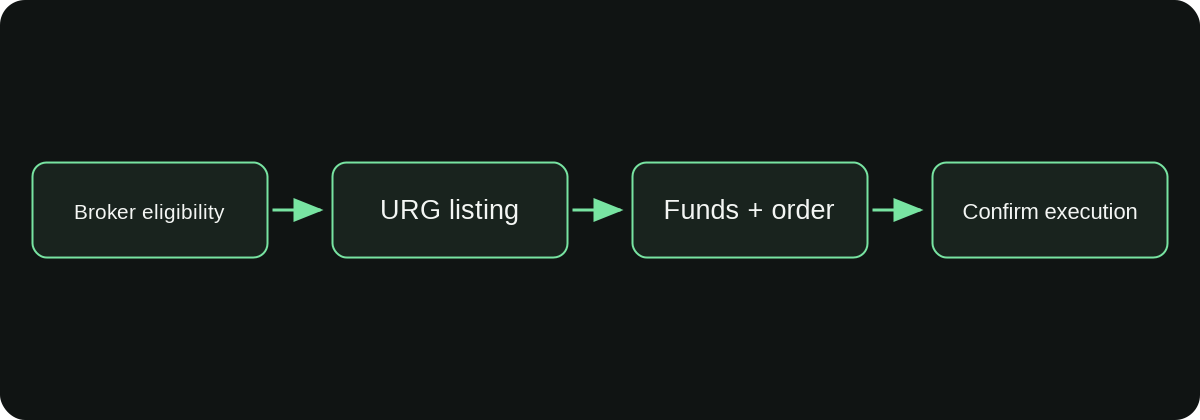
To buy URG Stock, use an eligible brokerage account that supports the NYSE American listing, fund it in the required currency and submit an order after checking the security and price conditions. Confirm the actual fill before assuming you own the requested quantity.
The process is straightforward only after access, funding and product identity are established. A search result showing the ticker does not prove your account can trade the ordinary shares on the intended venue.
Confirm the broker and your eligibility
Choose a brokerage legally available for your residence and account type. Review the entity serving you, its relevant registration and the protections or limitations attached to the account. Do not rely solely on an app name or promotional page.
Check whether the broker offers the actual listed equity, a derivative or another product referencing it. Those are different contracts. If you want common shares, verify that the instrument description matches that objective.
Ur-Energy’s official URG stock page helps establish the listing identity. Compare the issuer name and venue in the broker’s search result before proceeding.
Also review any restrictions affecting the particular security, session or order type. A broker can provide access to US stocks generally while applying additional conditions to some accounts or instruments.
Select the account and funding route
Determine whether you are using a cash account or borrowing through margin. Borrowing introduces financing costs and risks that are separate from the share purchase. Do not accept a margin setting merely because it is the app’s default.
Review deposit processing times and the difference between buying power and withdrawable cash. A newly deposited amount may be subject to holds or account rules. Ensure the purchase can be paid for under the applicable conditions.
If funding begins in another currency, inspect conversion costs and the currency balance created. A quoted commission of zero does not eliminate spread, foreign-exchange charges or other service fees.
Review whether an account minimum or currency-conversion threshold changes the practical purchase size. These broker conditions are separate from the number of shares you would ideally like to own.
Keep enough funds for the complete transaction. The relevant budget includes purchase value and applicable costs, rather than only the number of shares multiplied by a screenshot price.
Verify the listing and session
Search for Ur-Energy and URG, then confirm NYSE American and US dollars. Do not confuse the US route with URE on the TSX or a similarly named security.
Check the market calendar and your intended trading session. The NYSE hours page distinguishes regular, extended and holiday schedules. On a closed market, an entered order can wait rather than execute immediately.
Inspect bid, ask, available size and update time. The last trade is a historical transaction, not a promise that your entire order will execute at the same price.
The quote guide explains these fields. Understanding them before submission reduces avoidable confusion about a fill that differs from the displayed chart.
Choose an order instruction deliberately
A market order prioritizes obtaining an execution but does not guarantee the observed price. A limit order sets a maximum purchase price but can remain unfilled or fill partially. The appropriate trade-off depends on your task and conditions.
Investor.gov’s order-type bulletin describes those distinctions. Read your broker’s exact handling, especially for extended sessions and fractional shares.
For illustration, 200 hypothetical shares at a $1.25 limit create a maximum share-value commitment of $250 before costs if fully filled at that limit. The order might execute lower, partly or not at all. This is not a current URG quote or suggested order.
Set duration and session conditions carefully. A day order and a good-till-cancelled instruction do not behave identically. Check whether the broker expires or adjusts orders under particular circumstances.
Review the confirmation screen before sending
Check account, buy direction, security, quantity, order type, limit if used, duration, session and estimated costs. A small typo in quantity or direction can change the intended exposure significantly.
If the interface uses dollars instead of shares, inspect the resulting quantity and fractional-share rules. If the account has borrowing enabled, confirm whether the order uses settled funds or creates financing exposure.
Do not submit duplicates because the first request appears slow. Investor.gov’s online-investing guidance highlights the importance of checking order status rather than assuming an order failed.
Save the confirmation and wait for the broker’s execution record. A submitted or accepted instruction is not necessarily a completed trade.
Reconcile the fill and subsequent position
Review filled quantity, average execution price, charges and remaining open quantity. If only part of the order fills, decide what to do with the remainder rather than assuming the entire requested position exists.
A cancellation request can race with execution. Check the final status before replacing the order. Otherwise, the new instruction can create more exposure than intended if the original also fills.
Confirm the position in the correct account and retain the trade confirmation for records. US equity transactions generally use the T+1 settlement framework, but settlement and broker availability are separate concepts.
A purchase also begins an ongoing monitoring task. Record the thesis, cost basis and conditions for review. The risk guide helps keep company exposure distinct from the mechanics of placing an order.
Questions before the first purchase
Can I buy URG Stock with money I need next week?
A near-term obligation requires dependable liquidity, while an equity can fall sharply or become harder to exit at the desired price. Consider the purpose of the money before treating account access as a reason to buy.
Do all brokers support the same fractional order features?
No. Eligibility, session handling, transferability and order types can differ. Verify the specific security and account terms instead of applying a general app advertisement to every stock.
Does a completed purchase prove I paid fair value?
No. Execution confirms a transaction under market conditions. Evaluating business value, expectations and your own suitability is a separate task from successfully placing an order.