
URG Stock carries company-specific operating, financing and regulatory risks in addition to uranium-price exposure. The useful risk assessment traces each uncertainty to production, cash needs or shareholder claims. A list of generic warnings is less useful than understanding how losses could develop.
Start with the business you own and the obligations it must meet. Different risks can reinforce each other, so evaluating each in isolation can understate the effect of a difficult operating period.
Map risk to a financial consequence
Use four columns: trigger, business effect, financial consequence and evidence to monitor. A commodity decline might weaken future sales economics; a processing interruption might delay product; financing terms might change value per share.
Keep those consequences distinct. Lower revenue, higher costs, cash timing and dilution are different mechanisms. A share-price decline may anticipate any combination of them without identifying which one occurred.
Ur-Energy’s annual filing is a starting source for company-specific risk disclosures. Use later filings to identify developments rather than treating an old summary as permanently current.
A useful risk map should also record what would weaken the concern. Evidence of sustained operating improvement can matter, but an announcement of intended improvement is not the same observation.
Commodity exposure depends on commercial terms
A decline in uranium prices can affect uncommitted sales, future contracts and development incentives. Existing contracts can alter the timing and magnitude of that exposure. Do not assume either complete protection or complete spot sensitivity.
Review delivery quantities, pricing formulas and flexibility. A floor may provide partial support to a particular sale, while a fixed delivery obligation can still require the company to obtain material at an acceptable cost.
Also distinguish the price of uranium concentrate from conversion or enrichment prices. A fuel-cycle headline can be relevant to the sector without directly changing Ur-Energy’s realized sales price.
The contract guide evaluates these mechanics. For risk assessment, the question is how the commercial book behaves under adverse conditions, not simply how many future pounds have been announced.
Operational dependencies can compound
A wellfield must recover material, a processing system must handle it and logistics must support delivery. Improvement in one stage does not guarantee the entire chain performs at the same rate.
The company’s Shirley Basin description identifies a satellite relationship with Lost Creek. Shared processing can have economic advantages while creating a common operating dependency across sites.
Assess equipment reliability, water handling, recovery, staffing and transport as specific constraints. Ask whether a reported backlog concerns temporary scheduling or a continuing limitation. The answer needs operating evidence over time.
Do not infer the absence of risk from a facility being licensed or already operating. An established operation can still face maintenance, changing conditions and performance shortfalls. Compare actual results with the relevant assumptions.
Funding risk reaches shareholders through several routes
A company can need additional funds even while its projects make progress. Capital expenditure, working capital and ordinary spending may occur before related receipts. The timing can determine whether financing becomes necessary.
New equity can change ownership percentages. Borrowing can add repayment and other obligations. Convertible securities can affect both funding certainty and the potential share count. Read the terms instead of judging the transaction only by the amount raised.
A hypothetical company needing $20 million during a weak market may face different terms from one raising the same amount during favorable conditions. That is a scenario relationship, not a statement about a specific Ur-Energy financing.
Track available unrestricted resources, committed uses and financing options together. Do not treat restricted balances or a headline market capitalization as cash available to fund operations.
Permitting is a sequence of project-specific requirements
A uranium operation can require several approvals and ongoing compliance duties. A permit for one facility does not establish that every neighboring expansion or future activity is already authorized.
The NRC’s facility information explains the role of Agreement States, including Wyoming, in uranium recovery regulation. Identify the responsible authority and the relevant activity instead of assuming the NRC directly handles every approval.
For investors, a delayed authorization can change timing and funding needs even if the underlying resource remains attractive. A company describing baseline studies should not be reported as having completed permitting.
The Wyoming permitting guide maps those stages. In a risk file, preserve the difference between an application, an approval, construction and demonstrated operation.
Market liquidity changes how losses are realized
An equity position may be easy to value on a screen but harder to exit at that displayed price. Spread, available size, session and market conditions affect the result.
A stop instruction does not guarantee a sale at the trigger price. A limit can constrain the price but leave the order unfilled. Those are execution risks in addition to the business risks that motivated the price movement.
Choose a position size with the possibility of gaps and large losses in mind. Do not assume an order instruction makes the capital at risk identical to the distance between entry and stop.
For a full exit process, the selling guide separates submitted orders, fills, settlement and withdrawable proceeds. Each stage requires its own confirmation.
Review combinations rather than isolated worst cases
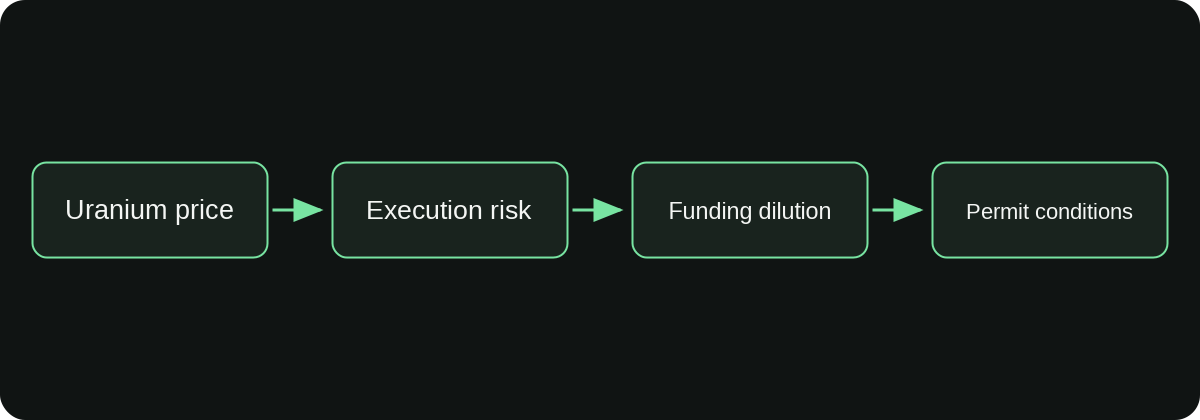
A weaker uranium market, an operating delay and expensive funding can occur together. A combined scenario can be more consequential than adding several unrelated warning labels to a watchlist.
Identify which assumptions share a driver. If your operating plan relies on rapid output growth and your funding plan relies on cash from that growth, they are not independent protections. A delay can affect both simultaneously.
Use the map to decide what evidence deserves attention and when to reassess. It should support a deliberate decision, not encourage constant reaction to every price fluctuation.
Risk questions that need separate answers
Does insurance remove the investment downside?
No. Coverage applies to defined events, terms and limits, not to every cause of a shareholder loss. Market-price declines or disappointing economics should not be treated as automatically insured.
Can a small position still be inappropriate?
Yes. Suitability depends on financial obligations, knowledge, concentration and loss capacity, not only the dollar amount. Funds needed for an essential near-term expense have a different purpose from speculative capital.
Does spreading money across several uranium miners remove sector risk?
No. It can reduce some company-specific concentration while retaining shared commodity, policy and market exposures. Examine the actual dependencies rather than counting securities as independent risks.