
URG Stock, Energy Fuels and Uranium Energy offer different uranium-related business exposures. Compare their operating models, commercial strategies and capital needs before comparing valuations. Similar sector labels do not make their assets or future cash flows interchangeable.
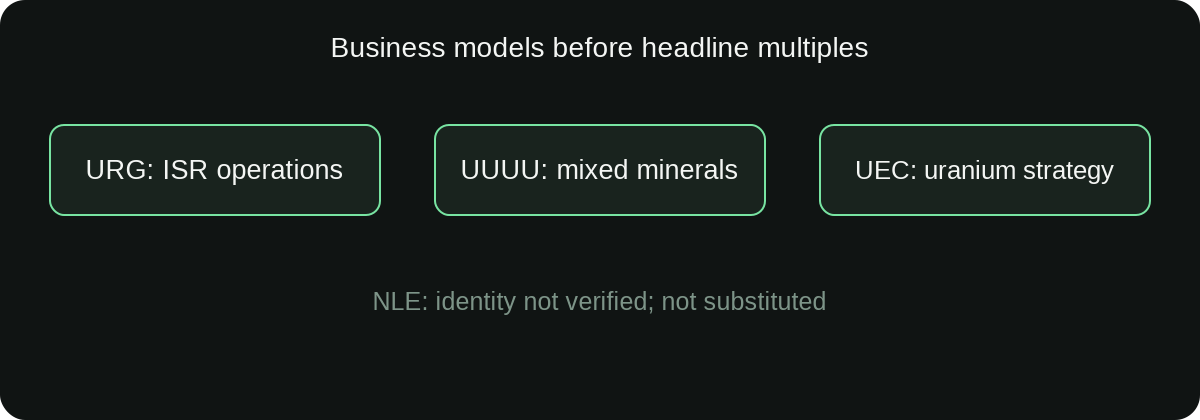
First correct the identifiers. Energy Fuels uses UUUU, not an assumed UUU. The requested NLE identifier was not verified as the intended peer, so no company profile or financial figures are invented for it here.
Establish the verified comparison set
Ur-Energy identifies URG on NYSE American. Energy Fuels’ October 2026 prospectus identifies UUUU on NYSE American. Uranium Energy’s 2026 annual filing provides the starting record for UEC.
Use full company names with those symbols in a worksheet. If an unfamiliar ticker appears in a search result, confirm the exchange and issuer before treating it as a uranium company.
NLR, if that was the intended search, is a VanEck uranium and nuclear ETF, not another operating miner. That clarification is not an assumption that NLE definitely means NLR.
The distinction matters because an investment comparison should not quietly substitute a different security. A verified two-peer analysis is more useful than a fabricated three-company table.
Ur-Energy: focus on the Wyoming operating chain
Ur-Energy’s operating overview describes its ISR uranium focus. The investment questions include recovery, processing, deliveries, commercial pricing and the funding required to execute the plan.
Its hub-and-satellite arrangement makes the relationship between sites important. More recovery activity at one location is not automatically the same as more finished product available for a customer.
Evaluate output definitions and inventory movements alongside the commercial book. A quarter’s deliveries can reflect material with a different history from the uranium currently being recovered.
The business-model guide covers that sequence in detail. In a comparison, use the same physical and financial definitions for the other companies before interpreting the numbers.
Energy Fuels: broader activities change the exposure
Energy Fuels’ corporate description identifies uranium alongside rare earths and other critical materials, with White Mesa among its processing assets. That is a broader business mix than simply treating every revenue opportunity as uranium mining.
A diversified project set can create additional potential sources of value and additional expenditure or execution requirements. It does not automatically mean lower risk or a better investment at any price.
Separate uranium assumptions from the economics of other activities. If an analyst values rare-earth development separately, inspect the resource, processing, customer and funding assumptions supporting that component.
Do not compare company-wide expenditure with a narrower uranium-only measure from another issuer. The difference may reflect business scope rather than operating efficiency alone.
Uranium Energy: inspect its own strategy rather than borrowing URG’s
UEC’s annual filing describes a uranium platform including hub-and-spoke ISR operations and development activities. Its stated unhedged uranium strategy creates a commercial contrast with a producer that has a disclosed contract book.
That distinction can matter under both rising and falling commodity scenarios. More direct market exposure can increase potential sensitivity while reducing some price visibility. The result still depends on production, inventory, costs and financing.
Do not turn an unhedged strategy statement into a guarantee that every share-price move matches spot uranium. Equity valuation includes expectations and company execution, and commercial strategies can change over time.
Check subsequent company releases for material changes between reporting dates. A new processing campaign, acquisition or financing can alter the comparison before the next annual statement appears. Record that event separately rather than silently blending a future plan into historical results.
Use the latest available disclosure for the comparison date. A strategy described in a fiscal-year filing should retain its period and should be checked against later material announcements.
Compare the economics with a common framework
Use a table of questions rather than an unsupported winner ranking:
| Dimension | What to compare |
|---|---|
| Business mix | Uranium exposure versus other activities |
| Operating stage | Current recovery, processing and development work |
| Commercial strategy | Contracted and uncommitted price exposure |
| Funding | Available resources against planned uses |
| Valuation | Claims per share under consistent assumptions |
Preserve fiscal-year differences. A July year-end and December year-end can produce differently timed annual figures. Align periods where possible and explain where the comparison remains imperfect.
Do not rank the shares by nominal price. Share count, obligations and potential dilution determine what that quote represents. A low-priced stock can imply a higher or lower valuation than a higher-priced peer depending on the denominator.
For a reusable process, the peer worksheet provides the detailed method. This named-company article concentrates on the verified business differences.
Let the scenario determine which differences matter
If your thesis concerns stronger uranium prices, compare how each business reaches those prices through its commercial strategy. If it concerns operating improvement, compare the specific bottleneck and evidence required.
If your priority is broader critical-materials exposure, a company with additional businesses may fit the research question differently. If your priority is minimizing one-company concentration, a relevant fund is a separate category to evaluate.
None of those purposes establishes a universal best stock. The appropriate conclusion states which assumptions favor one exposure and what would challenge them, rather than using a bullish sector story to rank every participant identically.
Before trading, verify the exact listing and current account support. A correct business comparison does not prevent an order error caused by an ambiguous ticker.
Comparison questions
Does UUUU’s additional business mix guarantee diversification benefits?
No. Activities can share funding, facilities or execution constraints, and their value depends on successful development. Assess the actual dependencies rather than assuming several product names create independent returns.
Can I use the same uranium-price assumption for all three companies?
A common scenario can help comparison, but apply it through each company’s commercial terms and business mix. The same benchmark does not imply identical realized prices or equity sensitivity.
What should I do with an unresolved ticker such as NLE?
Obtain the full issuer name and exchange before researching or trading it. Do not assume the nearest spelling or a similarly themed fund is the intended security.