
Ur-Energy’s business model involves recovering uranium, processing it into saleable product and delivering material under commercial arrangements. URG Stock reflects the economics of that company, including costs and financing. It does not simply reproduce the daily change in a uranium price indicator.
The clearest way to understand the business is to follow both the physical pounds and the accounting entries. They move through related processes but do not necessarily appear in the same reporting period.
Locate the business within the fuel cycle
Ur-Energy’s company overview identifies a uranium producer operating in Wyoming. Its role differs from a converter, enricher, fuel fabricator or electricity utility. Those activities belong to different stages of supplying nuclear fuel and generating power.
This distinction matters when evaluating industry news. A reactor announcement can influence expectations for eventual fuel demand, but it is not itself a sale by a uranium miner. The effect depends on procurement, timing and the company’s ability to supply material.
Likewise, a change in enrichment demand is not a direct change in Ur-Energy’s mining cost. Analyze the transmission between stages rather than grouping every nuclear development into one immediate revenue driver.
For the policy connection, the fuel-cycle policy guide follows the sequence from a government action to a possible company-level outcome.
Follow material through recovery and processing
The company’s ISR explanation describes a wellfield process that brings uranium-bearing solution to ion exchange, rather than excavating ore in a conventional mine. Further processing prepares the recovered material for shipment and sale.
For investors, the important implication is that recovery is a sequence. A pound captured in a process is not automatically a finished pound ready for delivery. Equipment availability, water handling and processing capacity can affect that conversion.
Ur-Energy’s Shirley Basin page describes its current satellite relationship with the Lost Creek processing hub. This creates a specific operational connection: progress at a satellite can still depend on logistics and processing at the hub.
Evaluate those linked stages together. Adding recovery capacity does not remove a bottleneck downstream, and improving a processing plant does not by itself create more recoverable material in a wellfield.
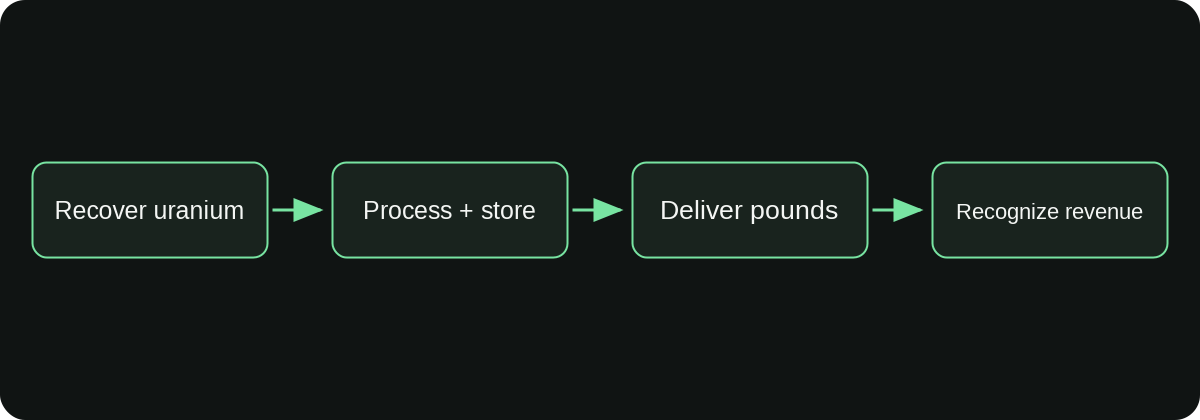
Revenue follows the sale, not every production milestone
Recovered material can remain in process or inventory before becoming a customer delivery. Financial reporting therefore needs to distinguish physical output, inventory movements and revenue recognition under the relevant agreements.
For illustration, a hypothetical producer begins with 40,000 finished pounds, adds 30,000 and delivers 50,000. Ignoring other movements, it ends with 20,000 finished pounds. Deliveries exceeded current output because inventory supplied the difference.
Those assumptions are not Ur-Energy figures. The example demonstrates why a strong sales quarter does not necessarily prove that current production reached the same level. The reverse is also possible when material accumulates before deliveries.
Use the company’s financial results and filings to reconcile the actual measures. Read definitions and reporting periods rather than assuming every pounds figure describes an interchangeable quantity.
Purchased and produced material can have different economics
A uranium company may deliver material with different acquisition or production histories. The cost attached to a sold pound can reflect inventory acquired earlier rather than the cash spent operating a mine during the current quarter.
That creates a margin-analysis task. Identify which cost measure covers which material and period. A cash production metric should not be substituted for total cost of sales across all delivered pounds.
Also distinguish operating cost from corporate cash requirements. Wellfield development, exploration, administrative spending, financing and restoration can matter to shareholders even when a narrowly defined production metric looks attractive.
The cost-per-pound guide addresses those definitions. The business-model question is broader: can the whole arrangement produce sustainable value after the expenditure required to operate and renew it?
Contracts shape when commodity prices reach the accounts
A company selling under a commercial contract may receive a price determined by earlier negotiations or a formula. Its realized sales price need not equal a current spot indicator.
Consider a hypothetical fixed-price delivery and a market-related delivery occurring in the same quarter. The first can provide price visibility while limiting immediate upside. The second can provide exposure to market movements while introducing uncertainty.
The relevant terms include volume, delivery year, escalation, floors, ceilings and flexibility. These can change the effect of a uranium rally or decline without changing the number of shares outstanding.
The sales-contract article examines the disclosed arrangements. Do not assume the word hedging necessarily means a financial derivative; a commercial sales agreement can also alter commodity exposure.
Cash flow tests whether growth can fund itself
Revenue and accounting profit do not always arrive as spendable cash at the same moment. Receivables, inventory and payment terms can create working-capital needs. Development expenditure can absorb cash before a project contributes sales.
A useful review therefore follows operating cash flow, investment spending and financing separately. Ask whether cash comes from customers, asset activity, borrowing or new equity. Those sources have different implications for future obligations and ownership.
Track unrestricted resources separately from cash pledged for a specific purpose. A balance-sheet total can look ample while some funds are unavailable for ordinary operating needs. Read the relevant notes before calculating a runway.
The earnings-reading workflow connects these items across statements. It helps explain why a uranium company can announce progress while still needing additional funding.
Business-model questions
Does licensed capacity equal an annual production forecast?
No. Capacity describes a permitted or designed boundary under specified conditions. Actual output depends on operating rates, resources, recovery and other constraints. Use current guidance and results to assess performance within that boundary.
Can an exploration success create revenue immediately?
Usually it creates evidence to evaluate rather than a completed sale. Technical interpretation, resource reporting, permits, construction and commercial arrangements may stand between an encouraging result and cash generation.
Is a larger resource estimate automatically better for existing shareholders?
It can improve a project’s potential, but development costs, timing, funding and ownership changes still matter. Evaluate the economics per share instead of multiplying estimated pounds by a headline uranium price.