
Nuclear policy can influence URG Stock through procurement, market access, fuel demand and operating requirements. The effect depends on implementation and Ur-Energy’s role in the fuel cycle. A favorable policy headline is not automatically a contract, revenue item or immediate increase in mining output.
The practical task is tracing a policy from its legal or administrative status to the company-level economics it could change. Several intermediate steps may determine whether the effect materializes.
Identify the instrument and its status
Start by asking whether the item is legislation, a final rule, a proposal, guidance, funding announcement or procurement action. These instruments do different work and become effective through different processes.
Record publication, effective date and any conditions. A consultation closing does not itself adopt the proposed rule. An authorization to spend does not prove a company has received an award.
For example, US nuclear fuel security legislation addresses support across several domestic fuel-cycle activities. Reading the scope is more useful than treating the words domestic uranium as a universal guarantee for every listed miner.
Keep the relevant authority and beneficiary group with the claim. An action affecting enrichment or government security requirements may operate differently from ordinary commercial uranium purchases.
Locate the affected stage of the fuel cycle
The Department of Energy’s fuel-cycle overview distinguishes mining, milling, conversion, enrichment and fabrication. These are connected activities, but they are not interchangeable products or revenue streams.
Ur-Energy’s business description places the company in uranium production. A policy supporting another stage can influence the broader system without being direct payment to Ur-Energy.
Map the route explicitly. A reactor-development policy may affect eventual fuel requirements; procurement timing and technology then influence demand for particular materials and services. A conversion or enrichment constraint can also affect the timing of fuel availability.
Do not skip from an industry objective to a precise stock-price effect. The missing steps are where many investment assumptions reside.
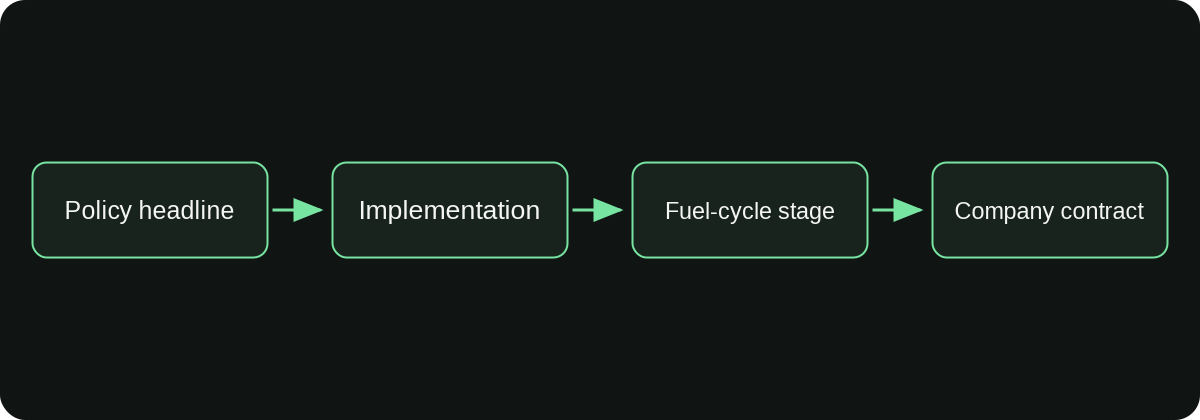
Distinguish direct procurement from indirect demand
A government contract awarded to a named company is different from a general program that might create future opportunities. Verify the recipient, product, amount, conditions and performance period before describing an award as revenue.
Even an actual award may involve milestones, cost sharing or later delivery. The accounting and cash effects depend on the agreement. A headline contract value need not become immediate profit.
Indirect demand is more conditional. Policies supporting nuclear generation can affect long-term uranium requirements, but fuel procurement may occur through utilities, traders and existing contracts. The timing can differ from reactor construction announcements.
Use commercial evidence to connect the policy to the company. A new signed sales arrangement provides a different level of information from management expressing optimism about a policy environment.
Consider costs and compliance as well as opportunities
Policy can change obligations, approvals, fees or restoration requirements. A supportive national objective does not necessarily remove site-specific environmental duties or automatically accelerate every permit.
The NRC facility information identifies Agreement State responsibilities for uranium recovery. In Wyoming, the relevant state role matters when evaluating an operating or expansion authorization.
A regulatory change can also have a limited scope. A proposal simplifying one review does not prove another agency’s requirement disappears. Read the actual provision rather than extending the headline to the entire permitting process.
The permitting article handles project-specific questions. Keep that evidence separate from broad political support for domestic nuclear energy.
Translate policy into a scenario worksheet
Use columns for policy action, affected activity, implementation condition, possible company effect and evidence required. For an indirect opportunity, identify the commercial step that would turn it into an observable benefit.
For illustration, a hypothetical funding program for fuel infrastructure might improve capacity only after awards, construction and qualification. A miner could benefit later if those changes support additional procurement. No part of that example establishes an award or sale for Ur-Energy.
Also model a delay scenario. If implementation takes longer than expected, consider what changes in project timing, cash needs or customer demand. A policy can remain directionally favorable while its benefit arrives later than an investment thesis assumes.
The market-balance guide connects demand timing with inventories and contracting. It prevents a policy scenario from assuming that every future requirement becomes a spot purchase immediately.
Keep stock-market interpretation separate
URG Stock can react to expectations before commercial effects appear. That does not prove the final benefit or its magnitude. Market participants can also revise expectations without a change in the legal instrument itself.
Check the announcement timestamp, market session and other news before attributing a specific price move. A broad sector rally can coincide with company-specific developments or changing equity conditions.
Do not infer that a favorable policy creates a price floor for the shares. Operating, financing and valuation risks remain. An investor can pay too much for a real opportunity or lose money while its implementation is delayed.
For current dated examples, the US policy news article distinguishes recent developments from this general transmission framework.
Update the evidence when implementation advances
Revisit the worksheet when an agency publishes a final action, a procurement notice, an award or a material operating result. State what has changed rather than merely refreshing a headline date.
Maintain links to the original documents and preserve earlier assumptions. If a proposed benefit does not appear, determine whether the issue is timing, eligibility, economics or an incorrect causal link.
That record turns policy monitoring into a research process. It is more useful for shareholders than treating every nuclear announcement as a reason to predict the same rally.
Policy questions
Does bipartisan support eliminate regulatory risk?
No. Political support does not complete technical review, site-specific approvals or compliance obligations. Evaluate the actual instrument and the requirements that remain for the relevant project.
Is a budget request the same as money received by a company?
No. Requests, appropriations, program decisions and disbursements are separate stages. Identify the completed stage and conditions before describing funds as available to a specific issuer.
Can a policy help the industry while hurting one company’s relative position?
Yes. Competitors, customers and other fuel-cycle activities can benefit differently. Examine the distribution of effects rather than assuming every participant receives the same economic advantage.