
Recent US nuclear-fuel developments can matter to URG Stock through the broader supply chain, but they should not be described as direct Ur-Energy revenue without a company-specific agreement. The latest relevant evidence includes agency implementation work and industry fuel milestones at different stages.
This update was checked on November 26, 2026. It distinguishes what authorities and companies actually announced from an investment inference about future uranium demand.
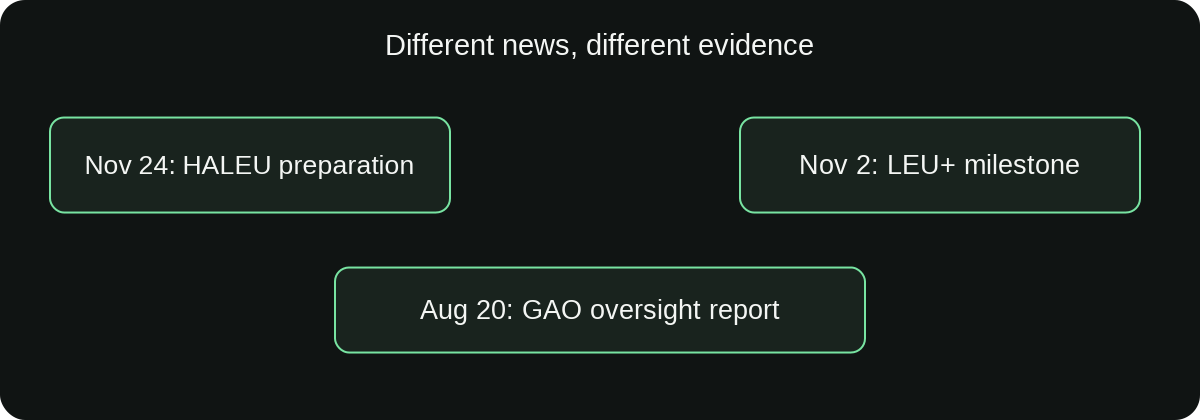
November 24: DOE reported a preparation milestone at Savannah River
The Department of Energy’s November 24 release says Savannah River Site was ready to begin chemical and mechanical preparations for H Canyon operations associated with producing HALEU for advanced reactors.
Preparation is not the same as completed commercial fuel delivery. The announcement concerns a defined government-site activity; it does not state that Ur-Energy received a new mining contract.
For an investor, the relevant inference is that advanced-reactor fuel infrastructure continues to require implementation work. Any effect on a particular miner depends on feed requirements, procurement, timing and the company’s ability to participate.
Do not collapse uranium recovery, enrichment and advanced fuel into one interchangeable product. The policy theme can be connected while the commercial stages and beneficiaries remain different.
November 2: an enrichment milestone provides industry context
Urenco’s November 2 announcement reports its first commercial LEU+ cylinder at Urenco USA. This is a company-reported enrichment development, not a new statute or an award to Ur-Energy.
Its relevance is the evolving fuel supply chain. A milestone in another activity can support the broader nuclear infrastructure story without establishing additional uranium sales for every miner.
Read the product, stage and stated customer use rather than treating the word uranium in a headline as sufficient proof of direct exposure. The fuel-cycle guide explains the transmission framework.
A commercial development and a policy action can appear in the same news cycle. Keep their categories clear so the article does not imply that all company progress results from one government decision.
August 20: GAO emphasized the quality of program analysis
The GAO’s August 2026 report addresses cost reporting and economic analysis for federal uranium supply efforts. Its publication is evidence of oversight and identified analytical needs, not proof that a particular recommendation has already been implemented.
For shareholders, the broader lesson is to examine program economics and execution, not only the size of a headline initiative. Government support can involve costs, conditions and implementation uncertainty that deserve scrutiny.
Do not convert an audit recommendation into a final rule or a guaranteed procurement schedule. Check subsequent agency action before reporting completion.
This also helps interpret ambitious industry announcements. A strategic objective can be real while the cost, timing and delivery mechanism remain important unanswered inputs for an investment model.
Trace the connection to URG Stock explicitly
Ur-Energy’s company overview describes a uranium-production business. A policy or industry milestone must reach that business through a plausible commercial or operating mechanism before you estimate a financial effect.
Possible links include future procurement, contracting conditions, market access or development incentives. Those are pathways to investigate, not facts established simply by the existence of a nuclear-policy headline.
Ask whether the event names Ur-Energy, specifies uranium concentrate, changes an applicable requirement or creates a verified customer opportunity. If it does none of those directly, describe the relevance as indirect and conditional.
Use the company’s filings and releases to confirm a material issuer-specific development. A government publication cannot substitute for a contract disclosure it does not contain.
Keep legal status and implementation stage visible
Use a news table with publication date, instrument or event type, completed action and next condition. A preparation milestone, company shipment and oversight report should not all be labeled a new regulation.
For a proposed rule, record the consultation and intended process. For an award, identify the recipient and terms. For a statute, check effectiveness and the activities covered. The appropriate evidence depends on the category.
This prevents two common errors: calling a proposal operational law and describing a legal authorization as money already received. Either can overstate the benefit to a listed company.
The permitting article addresses another boundary. National fuel-security support does not automatically complete Wyoming project approvals or remove ongoing environmental duties.
Separate the market reaction from the business effect
A sector can react to expectations before a program produces commercial results. That reaction is not proof of the eventual effect. Compare publication times, price observations and other news before assigning a specific stock move to one item.
URG Stock can also move because of operating results, financing or broader equity conditions. An attractive nuclear headline does not make those factors disappear.
If publishing a current-price reaction, use a verified quote with its session and timestamp. The price guide explains why a holiday or delayed observation can otherwise distort the story.
For the business outlook, compare the potential benefit with actual delivery capability, contracts and capital needs. A policy-supported opportunity can still require expenditure and time before it contributes to value per share.
What to monitor next
Follow agency implementation documents and company-specific commercial disclosures. For fuel milestones, look for the next operational stage and the evidence that it has been achieved, rather than assuming a preparation announcement completes the chain.
For Ur-Energy, continue reviewing its own projects and financial results alongside the policy environment. The Q3 recap provides the operating baseline against which broader opportunities need to be evaluated.
Update the analysis when a material condition changes. A new article date should reflect new evidence or interpretation, not simply repeat an older policy story with a more dramatic stock headline.
Policy-news questions
Does an advanced-reactor fuel milestone guarantee more near-term spot buying?
No. Material requirements and procurement depend on the program, inventories, contracts and schedule. Identify the actual buying mechanism before projecting a direct spot-market effect.
Can a government-site milestone be described as an Ur-Energy project update?
Not unless the source establishes that connection. Keep the operator and beneficiary clear. Industry relevance does not make another organization’s activity a company-owned asset or contract.
Should an oversight report be treated as evidence a program has failed?
Not automatically. Read the findings, recommendations and agency response. Oversight can identify improvements without establishing that every objective is impossible or every participant will suffer a loss.