
Ur-Energy’s Q3 2026 results show why URG Stock analysis must separate sales from current production. The company reported 190,000 pounds of uranium sold and about $12.3 million in product revenue, while captured and drummed material measured different stages of operations.
The reporting period ended September 30, and the release was published November 9. Those dates matter when comparing the results with later project news or a current stock quote.
Read the reported measures on their own terms
The company’s Q3 release and quarterly filing provide the result and definitions. The following selected measures should not be treated as interchangeable pounds:
| Measure | Q3 2026 observation | What it describes |
|---|---|---|
| Uranium sold | 190,000 pounds | Commercial deliveries in the quarter |
| Product revenue | About $12.3 million | Revenue associated with uranium sales |
| Average realized sales price | $64.95 per pound | Reported sales-price average |
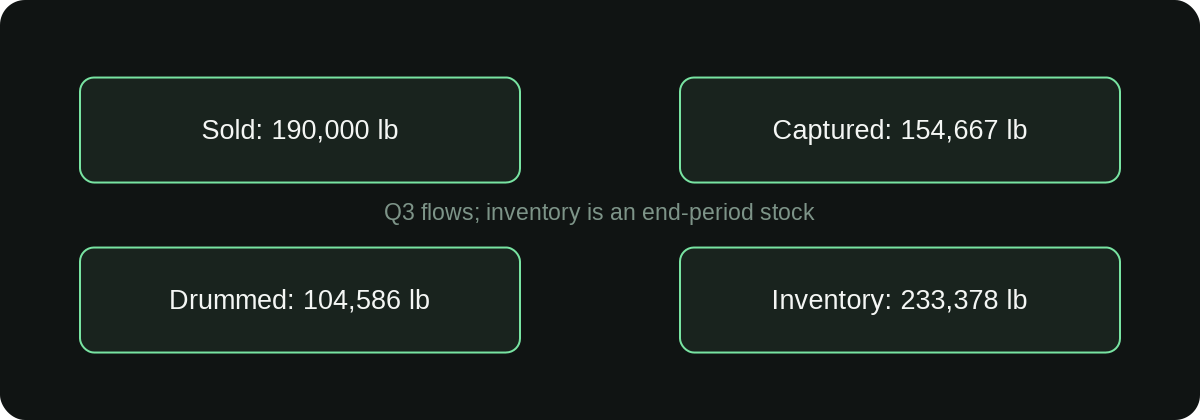
| Captured material | 154,667 pounds | A recovery-stage measure |
| Drummed material | 104,586 pounds | A later finished-output measure |
| Finished inventory at conversion facility | 233,378 pounds | A quarter-end balance, not quarterly sales |
The table is a selected operating snapshot, not a full financial statement. Its main value is preserving the distinction between a period flow and an ending stock of inventory.
Sales exceeded current drummed output for reasons that need reconciliation
The quarter’s delivered pounds were greater than its drummed pounds. That does not establish an accounting error, because sales can draw on inventory or material with a different acquisition history.
Read the produced and non-produced delivery categories in the filing before assigning every sold pound the economics of the current mine operation. The cost history of material matters to the quarter’s margin.
A simple inventory bridge should identify beginning balances, additions, deliveries and adjustments within the relevant category. Do not subtract one stage’s quantity from another and call the difference missing uranium.
The business-model guide follows the physical chain. It explains why an earnings recap must do more than choose the largest year-over-year percentage from the headline.
Captured and drummed measures point to conversion through the process
Captured material can precede later processing and packaging. A higher recovery-stage figure does not mean the same amount was immediately ready for customer delivery.
The release discusses work to optimize operations and supporting systems. The investment question is whether those changes improve the conversion of material through the chain on a sustained basis, not merely whether an upgrade is announced.
Compare several periods and the company’s explanation before drawing a trend conclusion. Timing and adjustments can affect a single quarter. Conversely, persistent differences deserve investigation rather than being dismissed automatically.
The Lost Creek overview explains the shared processing role that makes this conversion important. Satellite progress and hub performance should be evaluated together.
Interpret the cost headline using the relevant subset
The release’s produced-pound cash-cost measure does not describe the complete cost of every delivered pound or the company’s total cash requirement. Different material categories and accounting definitions can produce different margins.
Before subtracting a cost number from the $64.95 sales average, confirm that both cover the same population and period. Mixing a produced-only cost with an all-sales price can overstate or misdescribe the economics.
The cost-per-pound analysis provides the detailed comparison. It separates cash and broader cost measures and explains why neither one alone establishes corporate break-even.
Also inspect administrative, development and financing requirements. A positive spread within one material subset does not automatically mean positive company-wide free cash flow.
Keep quarterly and year-to-date growth separate
The Q3 release includes both quarter comparisons and growth across the first three quarters. A year-to-date percentage should not be rewritten as the growth rate of Q3 alone.
Use the correct denominator and matching period for every claim. A quarter-on-quarter change and a year-on-year change can point in different directions without either being wrong.
For a complete financial review, the earnings-reading workflow connects the income statement, balance sheet and cash-flow statement. It prevents a production headline from standing in for an overall profitability conclusion.
Preserve rounding as well. Dividing a rounded revenue headline by pounds may not reproduce the reported average exactly. Use the underlying tables rather than inventing extra precision from rounded inputs.
Distinguish delivery outlook from production guidance
The filing describes a revised commercial schedule with 700,000 pounds of 2026 base and fixed deliveries, including 460,000 sold through the first nine months. The arithmetic residual is 240,000 pounds for the remaining schedule, subject to subsequent changes and applicable terms.
That residual is not a statement that the company will produce exactly 240,000 new pounds in Q4. Deliveries and production are different measures, and inventory or other sources can affect fulfillment.
The sales-contract guide explains delivery flexibility and pricing. A commercial commitment needs to be assessed alongside available material, operating expectations and funding.
Do not turn a future schedule into completed results. The next relevant disclosures need to establish what was actually delivered and at what economics.
Put later project news beside the results
The November 17 Lost Soldier update came after the reporting period and results release. It concerns development-stage information rather than additional Q3 sales.
Keeping the chronology clear helps investors distinguish the operating baseline from later possible catalysts. A report targeted before year-end could change available information without immediately changing the completed quarter.
For URG Stock, monitor actual output conversion, cost definitions, material availability and commercial fulfillment. Those observations provide a more useful test of the thesis than assuming one headline establishes a guaranteed next-quarter improvement.
Q3 recap questions
Does ending finished inventory equal all material available immediately for any sale?
Not necessarily. Location, commitments, ownership and transaction conditions matter. Read the relevant definitions before treating an inventory balance as unrestricted cash or completely uncommitted product.
Can I annualize the quarter by multiplying every figure by four?
That is only a mechanical extrapolation. Delivery schedules, ramp-up, inventory and costs can vary. Label any such exercise as an assumption rather than company guidance or a reliable forecast.
Does a better operating metric guarantee a positive stock reaction?
No. The market compares results with expectations and other information, including funding and valuation. A genuine improvement can coexist with a disappointing share-price response.