
Lost Creek matters to URG Stock because it combines uranium recovery with processing infrastructure that can serve other company operations. Investors should evaluate its wellfields, processing and support functions together. More material captured elsewhere does not automatically become finished saleable output without that operating chain working.
A project overview is most useful when it identifies what the facility does, which constraints matter and what evidence shows progress. Licensed capacity and a large property are starting facts, not completed production results.
Understand the hub and satellite relationship
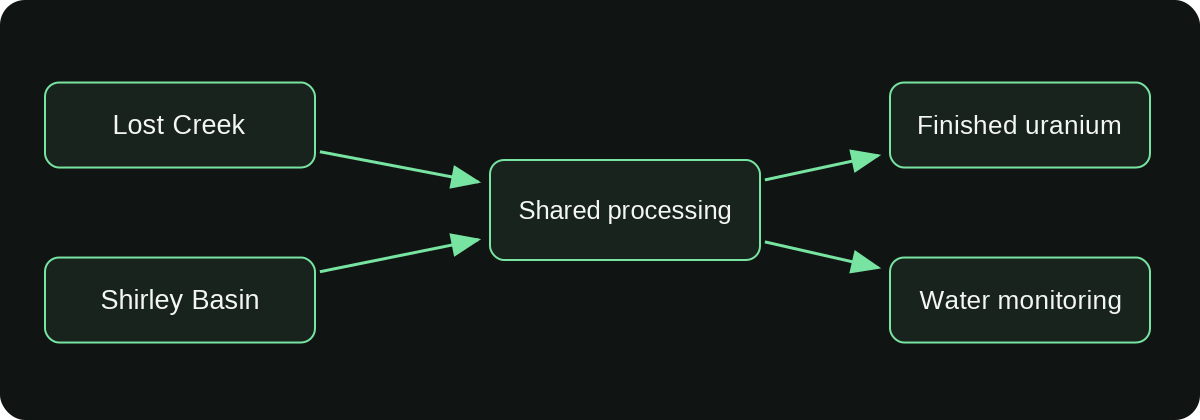
Ur-Energy’s Lost Creek page describes the Wyoming property as both a mine and a processing hub. Its Shirley Basin information explains that uranium-loaded resin is transported from the satellite operation to Lost Creek for further processing.
This arrangement can use shared infrastructure rather than duplicating every function at each site. But it also creates dependencies. Satellite recovery, transportation, unloading and hub processing all affect the route to finished product.
Do not value the sites as though every stage operates independently. A constraint at the hub can affect material coming from another site, while a satellite’s ramp-up does not necessarily imply an equal immediate increase in the hub’s finished output.
For the wider company sequence, the business-model guide distinguishes recovery, inventory, deliveries and cash. Lost Creek is a concrete example of why those stages need separate measures.
Follow the physical stages inside the operation
Begin with the wellfield: producing solution at the required rate and concentration is different from possessing a mineral resource. The geology, well configuration and operating conditions determine what reaches the recovery system.
Next consider capture and processing. Material can be captured before later treatment, drying and drumming are complete. A bottleneck at one stage can increase work in process even when another stage improves.
Finally consider shipment, inventory location and customer delivery. A pound at a processing facility is not identical to a delivered pound under a sales contract. Logistics and commercial acceptance can separate those events.
Track the relationship between stages over time. A single quarter’s gap can reflect timing, but a persistent imbalance deserves explanation. Avoid assuming either that all differences are harmless timing or that every temporary backlog proves failure.
Capacity is a boundary, not a utilization rate
A permit or design capacity describes an authorized or engineered capability under specified conditions. Actual production depends on available feed, recovery, equipment, staffing and supporting systems. The percentage used can change as operations develop.
A useful worksheet records licensed capacity, management’s current operating target and actual output in separate rows. Preserve each figure’s date and unit. Do not divide a quarterly result by an annual capacity without adjusting the periods.
For illustration, a hypothetical facility permitted for one million pounds annually but producing 100,000 in a quarter has not necessarily demonstrated a one-million-pound annual run rate. Four times the quarterly figure is 400,000, and seasonality or ramp-up can make even that extrapolation incomplete.
These are teaching numbers, not Lost Creek capacity or guidance. Their purpose is to distinguish a legal boundary from an observed operating rate and a forecast.
Water handling can be an operating constraint
ISR operations move and treat water as part of recovering uranium. Recovery and processing therefore depend on more than the uranium price or ore concentration alone. Supporting water systems and their permitted operation deserve attention.
The company’s November Q3 release discusses Lost Creek optimization and wastewater capacity while a treatment facility is under construction. Keep expected improvements separate from completed performance.
When evaluating such a project, ask which constraint the new equipment addresses, what commissioning requires and which measure should improve afterward. A construction milestone is useful evidence, but it is not the same as sustained operation at the intended rate.
Do not infer that a supporting-system upgrade eliminates all recovery or permitting risks. It may solve one specific limitation while others remain. The appropriate test is the actual operating result after implementation.
Expansion requires evidence beyond a large land package
Adjacent mineralization can create future opportunities, but the path from exploration to production includes technical interpretation, resource reporting, economics and approvals. A property boundary does not establish recoverable pounds or commercial viability.
Distinguish the operating mine from adjoining exploration areas. A presentation can discuss both on one map, yet their development stages and information quality may differ materially.
The technical-report archive is the starting point for the relevant resource and economic assumptions. Read effective dates, categories and limitations before using a promotional summary in a valuation.
The resource guide explains why measured, indicated and inferred material should not be merged into a single guaranteed inventory number. Potential expansion can matter without being treated as cash already earned.
Build a Lost Creek monitoring sheet
Keep separate rows for wellfield development, captured material, finished output, work in process, water-system milestones and satellite feed. Add the source date and the company’s explanation of changes.
Then record what would confirm or challenge your expectation. If an upgrade is meant to improve throughput, the next useful evidence concerns operating rates and finished output rather than another photo of equipment being installed.
Connect the operational sheet with costs and delivery commitments. An improvement matters economically when it changes the quantity, timing or cost of saleable material. A visually impressive facility is not itself a shareholder-return calculation.
Use the earnings-reading process to link those observations to reported accounts. This keeps the project analysis grounded in what the business produces and spends, rather than only what it could potentially do.
Lost Creek questions
Does proximity to a satellite eliminate transportation risk?
No. Shorter distance can help logistics, but equipment availability, handling procedures and processing compatibility still matter. Evaluate the actual transfer system rather than treating proximity as a guarantee of uninterrupted deliveries.
Can I value the processing plant separately from its feed sources?
You can model components separately, but avoid double counting shared value. A plant needs suitable feed, and satellite economics can depend on access to that same plant. State the assumptions connecting them.
Does a plant photograph establish commercial readiness?
No. It can show visible construction progress, but commissioning, approvals and sustained performance require other evidence. Use operating disclosures and relevant authorization records to assess readiness.