
A uranium resource estimate is not the same as a mineral reserve, finished inventory or cash available to shareholders. For URG Stock, preserve the category, effective date and economic assumptions of every estimate before using pounds in a valuation.
The distinction is material for Ur-Energy: operating production does not automatically establish proven or probable reserves under the reporting framework. A company can produce uranium while retaining important uncertainty in its resource-based development assumptions.
Separate geological confidence from economic classification
Measured, indicated and inferred resource categories reflect different levels of geological evidence. They should not be merged into one uniform quantity simply because each is expressed in pounds.
A reserve involves additional economic and technical assessment under the applicable framework. A resource is not converted into a reserve merely by multiplying its amount by a uranium price higher than a selected cost estimate.
Ur-Energy’s technical-report archive identifies the documents and disclosure frameworks relevant to its projects. Read the actual report and cautionary language rather than relying on the largest number in a presentation.
If comparing companies, align categories and ownership. One issuer’s measured-and-indicated figure should not be compared with another’s combined total including inferred material as though the confidence levels match.
Read the Lost Creek figures with their labels
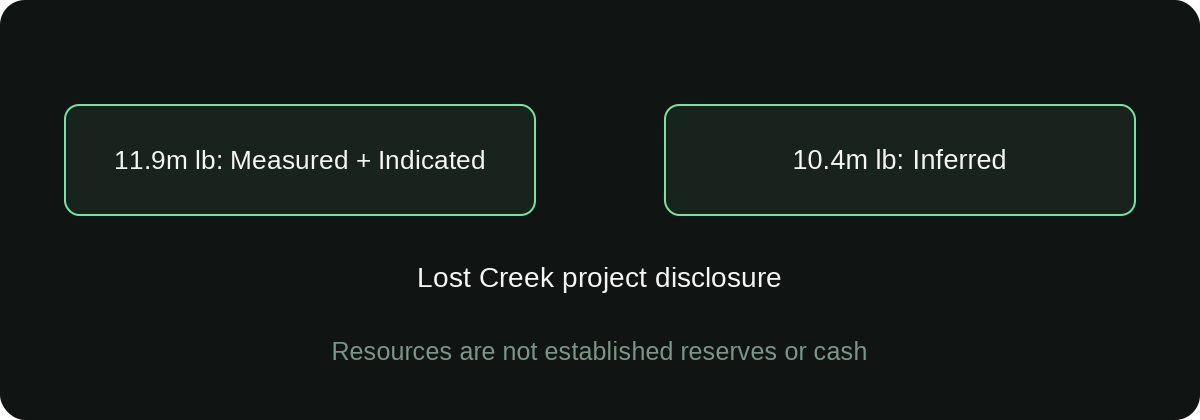
The company’s Lost Creek page identifies a technical report filed March 9, 2026 and reports 11.9 million pounds eU3O8 in measured and indicated categories, plus 10.4 million in inferred resources.
Keep those categories separate. The reporting unit also belongs with the figure; do not silently describe the estimate as finished drums ready for customer delivery.
The project page notes the preliminary nature of the assessment and limitations on inferred resources. Those qualifications affect valuation, not merely legal formatting at the bottom of a webpage.
A current production result answers a different question. It can provide evidence about operating performance but does not retroactively make every resource pound a proven reserve or recoverable inventory item.
Check what the annual report says about reserves
Ur-Energy’s annual filing states that it has not established proven or probable reserves for its ISR projects and describes the resulting uncertainty. Preserve that distinction despite the existence of operating facilities.
This avoids the opposite mistakes of calling all resources reserves and assuming an exploration-stage reporting classification means no uranium can be produced. Operational status and reserve classification describe different aspects of the business.
Use the company’s exact disclosure and applicable framework when writing about the status. Do not replace it with a generic stock-screening category or a casual description of the company as fully de-risked.
The ISR article explains why recovery conditions and actual performance remain relevant even where mineralization has been identified.
Understand the assumptions behind a resource change
A reported increase can reflect additional drilling, revised interpretation, changed cutoff assumptions or a different reporting boundary. It is not necessarily all newly discovered uranium.
Compare effective dates and the areas included. A report published this year can use a data cutoff from an earlier date. Preserve that difference when comparing it with a new exploration release.
Check the estimation and measurement definitions as well. The meaning of an equivalent-grade unit, ownership percentage or included project can affect the comparison. If you cannot reconcile them, leave the limitation visible rather than force an exact growth percentage.
The drilling guide helps trace field information toward a formal estimate. A hole-count update is not automatically an amendment to the latest technical resource total.
Do not value the company by multiplying pounds by spot price
That multiplication produces an in-ground gross metal reference under broad assumptions, not equity value. It omits recovery, operating and development costs, timing, taxes, obligations and the financing required to execute the project.
For illustration, a hypothetical ten-million-pound estimate at a $70 price gives a $700 million gross product. It does not establish a $700 million project value or a corresponding share target. These numbers are invented for explanation.
A proper project model needs assumptions about when material is recovered and sold, how much is recoverable and what expenditure is required. Discounting and uncertainty also affect the interpretation.
Then connect project value to the corporate capital structure. Debt, other obligations, cash and potential dilution can change the value attributed to each existing share.
Watch for double counting across documents
A project total can already include several areas described separately elsewhere. Adding the umbrella estimate to each component would count the same material more than once.
Similarly, two listings do not create two sets of resources. URG and URE relate to the same issuer. A company-wide figure should not be added to the value of its projects without reconciling what the figure already contains.
For multiple projects, keep a table of boundary, category, ownership, effective date and source. Add only comparable non-overlapping amounts when aggregation is appropriate, and preserve the categories in the result.
The peer worksheet uses the same discipline. An impressive total can conceal less useful information than a smaller but clearly classified estimate.
Use technical evidence to frame the next decision
A resource estimate can support planning and further investigation without establishing a construction decision. An economic assessment can add assumptions that still need validation through later work and operating performance.
Record what evidence remains relevant: recovery, hydrogeology, approvals, capital requirements and the commercial route. The next milestone should be tied to the uncertainty it could reduce.
For an equity outlook, the valuation article keeps those assumptions explicit. It avoids converting geological potential directly into a precise market-price prediction.
Resource-reading questions
Can inferred material be treated as equally certain as measured material?
No. The categories communicate different confidence levels. Preserve them in a comparison or model and apply the relevant technical-report limitations rather than assuming every pound has the same reliability.
Does an independent technical author guarantee economic success?
No. Qualified technical work provides a defined assessment under assumptions and evidence. It does not remove future operating, market, permitting or funding uncertainty.
Is a report’s publication date always its resource effective date?
No. Read both fields and any data cutoff. Using the publication date as though all measurements occurred then can misstate how current the underlying estimate is.