
A responsible late-2026 URG Stock outlook should use conditional business and valuation scenarios, not an invented year-end price target. With November 26 already late in the year, distinguish catalysts that could be reported soon from operating benefits that may take much longer to develop.
The useful question is what the current investment thesis requires and how new evidence could change it. A calendar-year label does not make uncertain outcomes predictable.
Start with the remaining calendar, not an old annual forecast
Ur-Energy’s November 17 update described a Lost Soldier technical report targeted before year-end, with a construction decision to follow review. A target remains conditional until the relevant event occurs.
For an equity outlook, a report can change the information available without creating immediate operating revenue. Its resource, engineering and economic assumptions would need to be examined before estimating the effect on value.
Check the company news archive for subsequent developments. Do not recycle a forecast written early in the year as though its assumptions and remaining time are unchanged.
Also distinguish publication timing from financial measurement. A November release covering Q3 is evidence about a period ended in September, not a complete observation of the fourth quarter.
Build the operating scenarios before the share values
Use separate assumptions for recovery, finished output, deliveries, realized prices and costs. State which are observed, management targets or your own hypothetical inputs. Do not blend those categories into one supposedly factual forecast.
An improvement scenario might involve better conversion of captured material into finished product and more reliable delivery execution. A cautious scenario might involve slower progress, additional spending or delayed commercial benefits.
The scenario should identify what would support or challenge it. A construction milestone can matter, but the relevant later evidence may be sustained throughput or cost performance rather than another announcement.
The earnings-reading guide helps connect those assumptions with statements. A plausible operating narrative is not enough unless the financial and funding consequences are also modeled.
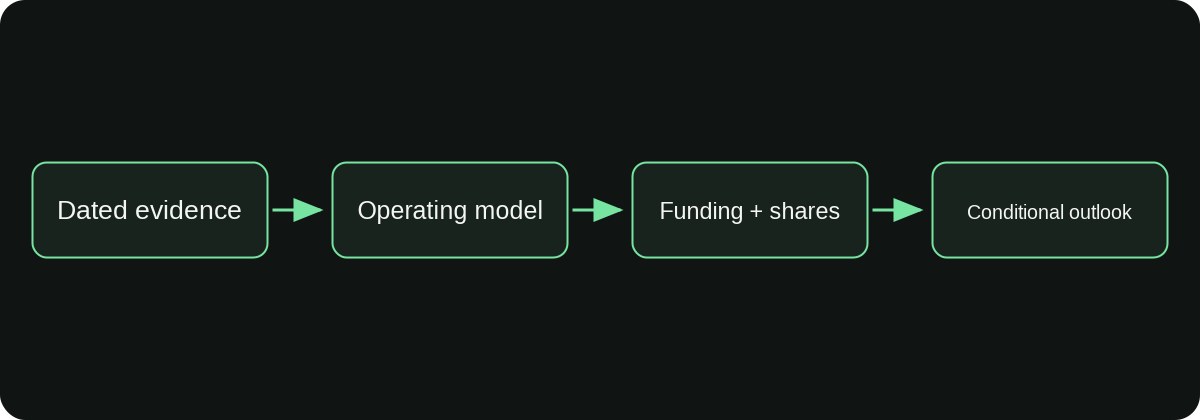
Translate business value into value per share
A simplified equity framework begins with operating or project value, then adjusts for relevant cash, obligations and other corporate items. The resulting equity value must be divided by a share count appropriate to the scenario.
Potential dilution should not be ignored where financing or conversion assumptions make it relevant. Equally, do not automatically treat every potential security as exercised without considering its terms and scenario conditions.
For illustration, hypothetical equity value of $150 million implies $1.50 per share at 100 million shares and $1 at 150 million shares. These are invented inputs, not a URG valuation or price target.
The example shows why a company can grow while value per existing share responds differently. The denominator is part of the forecast, not a fixed afterthought.
Use sensitivity ranges without invented probabilities
Create a range for uranium prices, output, costs, capital requirements and timing. Identify which assumptions dominate the valuation. A small change in a sensitive input can matter more than several impressive but less material project details.
Do not assign precise probabilities without a defensible method. Labels such as optimistic, central and adverse can organize assumptions, but they do not make the central case the most likely outcome automatically.
Also consider interactions. A weaker uranium market can affect both future sales and financing terms. An operating delay can change capital needs and the timing of receipts. Independent-looking spreadsheet rows may share one underlying risk.
The downside article provides a stress framework. Use it to test the thesis rather than treating a favorable uranium forecast as protection against company-specific loss.
Verify chart levels from a dated series
Support and resistance observations require a defined chart, interval, session and adjustment basis. A level copied from a search preview can be stale or based on settings different from your own.
Use the current URG quote route and a reproducible historical series. Record the date and method used to identify a level, such as repeated prior turning points over a stated range.
No numeric support or resistance is invented here from an unavailable live dataset. A useful level must be verified against the actual observations, and it remains a market-history interpretation rather than a guaranteed price boundary.
The indicator guide explains why technical evidence and business valuation answer different questions. Combining them requires clear roles, not treating agreement between two tools as certainty.
Check market timing before describing a current reaction
The NYSE calendar lists November 26 as Thanksgiving in 2026. A quote shown on the holiday can be a previous-session reference rather than a new regular-session observation.
Do not describe an unverified holiday price as a live reaction to a development. Match event time, trading session and source before reporting a percentage move or catalyst response.
A short remaining calendar can also amplify the difference between a possible announcement and realized economics. A report published before year-end may inform a decision whose operating consequences extend well beyond December.
For current event context, the news guide separates those stages. Keep the forecast horizon aligned with what can reasonably be observed in that period.
Turn the outlook into a reviewable plan
Record the assumptions, source dates and next evidence to check. State what would invalidate the thesis, not only what would support it. That makes an update more useful than repeatedly raising or lowering an unexplained target.
If considering a position, compare possible losses with your purpose, concentration and required liquidity. A valuation range does not guarantee an executable exit or make borrowed exposure appropriate.
Do not judge the model solely by whether a later quote briefly touches one output. Evaluate whether the assumptions and economic reasoning held up. A lucky price match is not evidence of a reliable forecasting process.
Outlook questions
Does a year-end target have to equal a project’s modeled value?
No. Project valuation, corporate equity value and a short-term market quote are different quantities. The market can price expectations differently and on a different timetable from a project model.
Can I use an analyst average as my own forecast without reading the inputs?
It is a summary of other views, not a substitute for their dates, methods and assumptions. Different targets can use different horizons and share counts, making a simple average difficult to interpret.
Should a missed catalyst date automatically mean the whole thesis is false?
Not necessarily. Assess whether the issue is timing, economics or a changed premise. A delay can be material without proving every underlying assumption wrong, and it should still be reflected in the model.