
A uranium-price crash could pressure URG Stock through future selling prices, development economics, inventory and funding conditions. The impact would depend on commercial protection and operating performance. It cannot be calculated responsibly by applying a fixed multiple to the uranium-price decline.
A useful downside model separates the commodity shock from the company’s ability to supply contracted material and finance its plan. Then it asks which assumptions could deteriorate together.
Define the shock and time horizon
State which uranium benchmark falls, by how much and for how long in the scenario. A brief spot-market dislocation and a prolonged weakness in future contracting can have different effects.
TradeTech’s price definitions distinguish assessed indicators. Do not describe a move in a thin futures contract as a universal collapse in every commercial uranium price.
Also define the equity horizon. A near-term market reaction can anticipate outcomes years ahead, while reported financial results reflect actual deliveries and accounting over a specific period. The two can move on different schedules.
Use the benchmark guide to identify the correct series. A stress scenario should begin with an explicit input rather than the ambiguous phrase uranium is down.
Separate covered sales from future opportunities
Ur-Energy’s quarterly commercial disclosures describe contracts with different pricing structures. Evaluate the relevant covered quantities rather than assuming every delivery reprices instantly at the new spot level.
Fixed or floor-protected terms can cushion part of a decline. Uncommitted material and later contract renewals can remain exposed. The amount of protection depends on the actual terms, timing and ability to deliver.
A weak market can also reduce the attractiveness of expanding production even when existing commitments retain some price support. That effect concerns future investment incentives rather than only the next reported quarter.
The contract article provides the detailed framework. Its central distinction is between price protection for a defined sale and immunity from all business downside.
Build a simplified operating sensitivity
Use separate assumptions for quantity, realized price, variable cost and other modeled costs. Do not use the current stock price as an input to the mine’s operating margin.
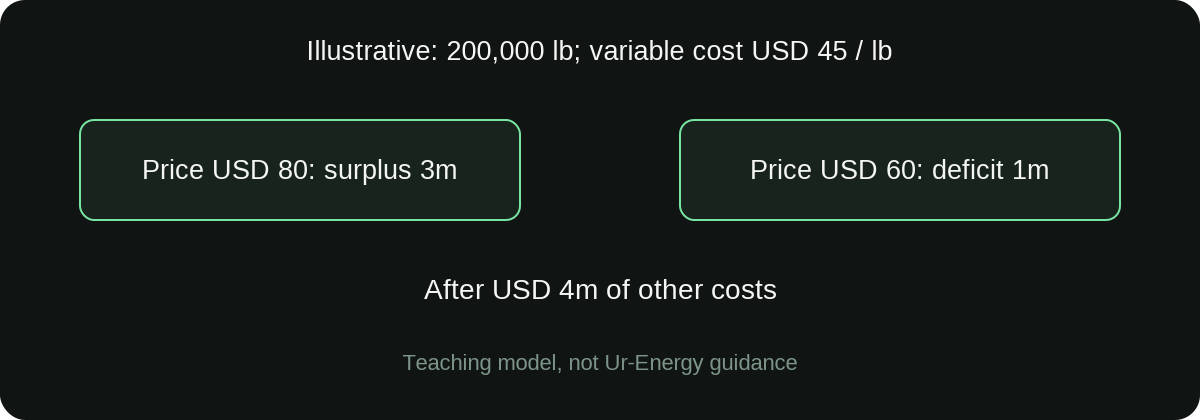
For illustration, assume 200,000 hypothetical pounds sold, a $45 variable cost and $4 million of other modeled costs. At a realized price of $80, the simplified surplus is $3 million. At $60 it becomes negative $1 million.
These inputs are invented, not Ur-Energy guidance. The calculation is quantity multiplied by realized-price-minus-variable-cost, then less other modeled costs. It omits several real accounting and funding items.
Its value is showing that a $20 selling-price change can matter differently depending on volume and cost structure. If some volume remains protected by contracts, apply the price scenario separately to each portion.
Add operating and funding stress rather than holding everything constant
A commodity downturn can coincide with weaker investor appetite or more expensive financing. A model assuming both lower prices and unchanged access to cheap capital may understate the downside.
Likewise, output can fall short while costs remain. Some expenditure does not decline proportionally with fewer pounds. A fixed-cost base can make a smaller operating shortfall more consequential.
Test several combinations: price-only weakness, price plus output weakness, and price plus funding difficulty. Do not assign invented probabilities. Identify the conditions and evidence that would make each scenario more plausible.
At the shareholder level, include potential dilution. A company raising capital to preserve its operating plan can survive a difficult period while changing value per existing share. Business survival and investment return are different outcomes.
Examine inventory and procurement effects carefully
Lower market prices can affect the value or economics of inventory under the applicable accounting policy. An accounting adjustment is different from a cash payment, but it can signal a change in expected realizable value.
For material that must be obtained for a future delivery, a lower market could reduce some procurement cost. That does not automatically offset every adverse effect elsewhere in the business. Timing, quality and contract conditions matter.
Keep obligations denominated in pounds distinct from obligations denominated in cash. The ability to buy material later depends on availability and liquidity, not only a lower indicator on a chart.
Use the earnings-reading process to distinguish inventory changes, cash flow and realized sales. Do not count the same economic effect twice in an income model and cash model without reconciling it.
Consider management’s available responses
A company may adjust development pace, spending, inventory or contracting where permitted. Each response has trade-offs. Delaying expenditure can conserve cash while postponing future output or changing commercial flexibility.
Do not assume every cost can be removed immediately. Operational requirements, employee commitments, agreements and regulatory duties can limit the response. An operating site is not simply switched off without consequences.
Evaluate proposed actions against the actual project and obligations. Ur-Energy’s filing directory provides the source record for those company-specific constraints.
The risk map helps identify which pressures share a common driver. It is particularly useful when the downside scenario combines operating and financing problems.
Translate the stress test into a review plan
Identify which assumptions dominate the result and what evidence would change them. A stress model is useful when it reveals a vulnerability, not when it produces a dramatic but unsupported stock target.
For an existing position, compare the modeled loss possibilities with your financial purpose and concentration. A stop order can help express an exit plan but cannot guarantee protection through a gap.
Keep the scenario date and assumptions. If uranium weakens, update the relevant inputs rather than treating every price decline as proof the worst case has occurred. Conversely, do not dismiss a real thesis change because a rebound is possible.
Downside questions
Could lower uranium prices ever help part of a producer’s costs?
Potentially, where material needs to be acquired at market-related prices. That limited effect should be assessed against sales, inventory and development exposure rather than treated as a general benefit from a downturn.
Does a cash balance guarantee the stock will recover?
No. Cash can provide time and flexibility, but spending needs, obligations and future economics determine what it can accomplish. A balance-sheet buffer is not a share-price floor.
Should I calculate a share target directly from a percentage uranium decline?
No fixed conversion is justified. Use a company model with commercial, operating, funding and share-count assumptions, and preserve the uncertainty of both the inputs and the resulting valuation.