
Uranium supply and demand can influence URG Stock through contracting, realized prices and development incentives, but an apparent shortage does not guarantee a share-price rally. Inventories, procurement timing, fuel-cycle conditions and company execution determine how the market balance reaches shareholders.
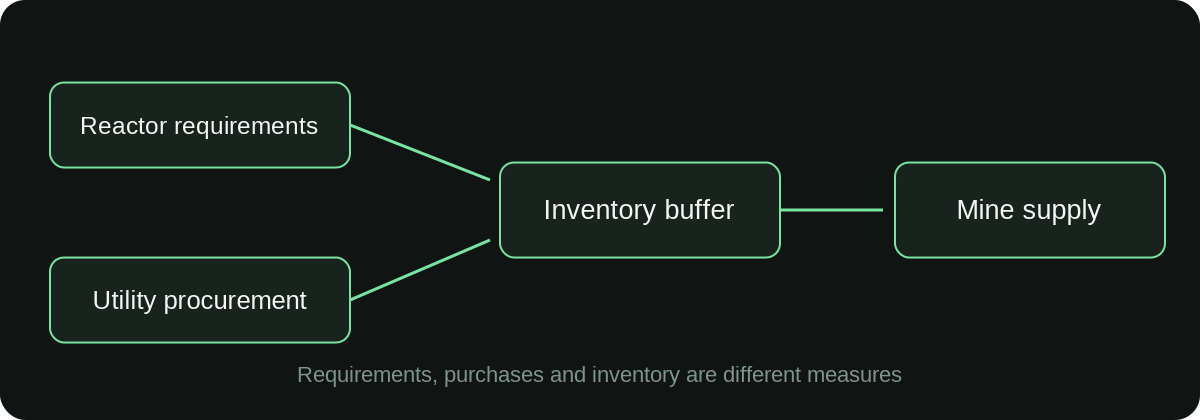
Begin with what the data measures. Reactor requirements, utility purchases, mine production and available inventory are related quantities, not interchangeable definitions of demand and supply.
Distinguish consumption from procurement
A reactor uses fuel under an operating schedule, while utilities can purchase uranium years before it is loaded. A procurement year therefore need not match the year the material is ultimately consumed.
The EIA’s 2025 Uranium Marketing Annual Report, released in 2026, reports 46.9 million pounds of utility purchases in 2025. It separately describes material types, contracts, deliveries and inventories.
That historical purchase amount is not a live 2026 demand reading or an estimate of what every producer can sell today. Preserve the year and purchaser population before using it in a market model.
For URG Stock, the relevant question is how procurement activity affects the company’s available opportunities and actual commercial book. A broad demand estimate does not itself determine Ur-Energy’s customer deliveries.
Understand the role of longer-term contracting
The EIA report states that 13% of uranium delivered to the surveyed US utilities in 2025 was purchased under spot contracts, with 87% under longer-term contracts. That is a specific historical delivery mix, not a universal constant.
It illustrates why a daily spot headline cannot describe the whole market. Utilities and suppliers can negotiate future deliveries under terms that differ from the spot assessment observed today.
A producer’s contract renewal and uncommitted volumes can therefore matter as much as current spot sentiment. Read the actual delivery years and pricing terms rather than valuing every future pound at one indicator.
The contract article applies that distinction to Ur-Energy. The benchmark guide separates spot assessments from historical realized prices.
Inventories can bridge a production gap
Material held by utilities, traders or other market participants can affect how quickly a difference between mine output and requirements reaches new procurement. Inventory is not all identical in location, ownership or readiness for use.
Separate material available for sale from material committed to another purpose. A published aggregate does not establish that every pound can enter the market immediately or at the price you assume.
For illustration, a hypothetical annual requirement of 100 units and mine supply of 90 leaves a ten-unit difference. Existing usable inventory could cover part of it for a period. That arithmetic does not prove a permanent surplus or eliminate the need for future production.
The example is a teaching model, not a forecast. A market-balance conclusion needs the actual definitions, timing and accessibility of each source.
New mine supply requires more than a high price
Higher expected prices can improve development incentives, but projects still need technical work, approvals, funding, construction and operating performance. A resource announcement is not the same as deliverable uranium next quarter.
Restart and ramp-up schedules can also be uncertain. The ability to recover material, process it and meet customer conditions determines how quickly an operating plan becomes market supply.
Ur-Energy’s operating overview places its projects within that production task. Company-level evidence should be evaluated separately from a sector forecast about future pounds.
A market model that assumes every proposed project starts on schedule can overstate supply. One that excludes all new projects despite improved incentives can understate it. Use scenarios and identify the assumptions that drive the difference.
Fuel-cycle bottlenecks complicate the demand story
The Department of Energy’s fuel-cycle explanation distinguishes mining, conversion, enrichment and fabrication. Capacity at one stage does not automatically resolve a limitation at another.
A reactor-development announcement can create long-term interest while the timing of fuel needs depends on construction and procurement. Changes in the fuel cycle can also affect the quantity and timing of natural uranium requirements.
Do not translate every enrichment price movement directly into a miner’s uranium revenue. Identify the mechanism and customer behavior that could connect them before estimating the effect.
The policy transmission guide provides a structured way to trace those links. It keeps an industry objective separate from a confirmed company order.
Translate market scenarios into company assumptions
For a stronger market, ask how much Ur-Energy could sell under existing terms, what remains exposed and whether operating output can support delivery. Potential pricing benefits still require material and commercial execution.
For a weaker market, examine existing price protection, uncommitted exposure and the cost of meeting obligations. A producer with contracts can behave differently from an entirely uncommitted resource developer.
For either scenario, include funding and dilution. An attractive market opportunity can require substantial expenditure before generating receipts. Shareholder value depends on how the company finances that interval.
The URG–uranium relationship article explains why commodity and stock returns need not match. A supply-demand thesis is one input to equity analysis, not a complete valuation.
Keep an outlook auditable
Record the source year, market coverage, unit and assumptions behind every balance figure. Distinguish an observed delivery from a forecast requirement and a proposed mine from operating output.
Update the model when evidence changes rather than merely changing the headline date. If a project slips or a procurement pattern changes, show which scenario inputs are affected.
Avoid assigning an exact future URG share price to a broad uranium deficit without a company model. A plausible market view can still produce poor investment results if the purchase valuation assumes more success than the business delivers.
Market-balance questions
Does an announced reactor automatically increase next year’s uranium purchases?
No. Construction, commissioning, fuel design and procurement schedules determine the timing. A long-term demand possibility should not be reported as an immediate spot order without evidence.
Can a uranium market remain tight while a miner reports weak earnings?
Yes. Operating constraints, costs, inventory mix and commercial terms can offset favorable sector conditions. Evaluate the company’s realized economics rather than treating the market thesis as a quarterly result.
Should all estimated resources be counted as future supply?
No. Resources need technical and economic assessment, permissions and development before becoming production. A credible supply forecast distinguishes operating, developing and speculative sources and preserves their timing uncertainty.