
Ur-Energy’s uranium sales contracts can change the price and timing exposure behind URG Stock. Read delivery obligations, fixed and market-related pricing, escalation and flexibility together. A commercial contract is not automatically a financial hedge or a guarantee of profit.
A contract can provide revenue visibility while still requiring the company to deliver material at an acceptable cost. The useful question is what remains exposed under different operating and uranium-price conditions.
Separate a sales agreement from a derivative hedge
A sales contract establishes commercial terms for material delivered to a customer. A financial derivative can create a different exposure and settlement structure. Do not use the word hedging to imply the company has entered a particular derivative unless it discloses that arrangement.
Ur-Energy’s Q3 2026 filing describes escalated fixed pricing and market-related pricing subject to floors and ceilings in parts of its sales book. The actual agreements differ, so one formula should not be applied to every delivery.
For shareholders, these commercial terms can reduce or reshape commodity exposure without eliminating operating risk. A known selling price is useful only in relation to the cost and ability to supply the required material.
The business-model article explains the route from recovery and inventory to a completed delivery. Keep that physical obligation beside the price formula.
Read the delivery schedule before estimating revenue
Record base quantities, optional amounts, delivery years and any disclosed flexibility. Distinguish a customer option from a firm base requirement. An announced multi-year total is not annual production guidance.
Following the changes described in the filing, base and fixed deliveries were stated as 700,000 pounds for 2026 and 1,355,000 for 2027. Preserve the disclosure date and scope; these figures do not represent guaranteed internally produced output.
A delivery deferral changes timing and potentially the financing or inventory plan. It should not automatically be described as a cancellation or as new incremental sales. Identify which quantity moved and what remains required.
For each year, compare deliveries with available inventory and the operating assumptions needed to supply them. A gap is a question for the plan, not evidence that all contracted material must come from current-period mine production.
Understand fixed prices, escalation and market linkage
A fixed-price arrangement can provide visibility relative to an uncertain future market. Escalation can alter the price through time. The exact base date and formula matter, so do not substitute a simple constant price without checking the terms.
Market-related pricing can connect the delivery price to a benchmark under the agreement. The observation window and any adjustment can matter. A daily spot print may not be the contract’s reference.
A floor can limit downside for a particular formula, while a ceiling can limit upside. Those features apply to the covered quantity and conditions, not automatically every pound the company might produce.
For benchmark definitions, use UxC’s market-price explanation and the uranium tracking guide. Identify the commercial reference before modeling price sensitivity.
Model the covered and uncovered portions separately
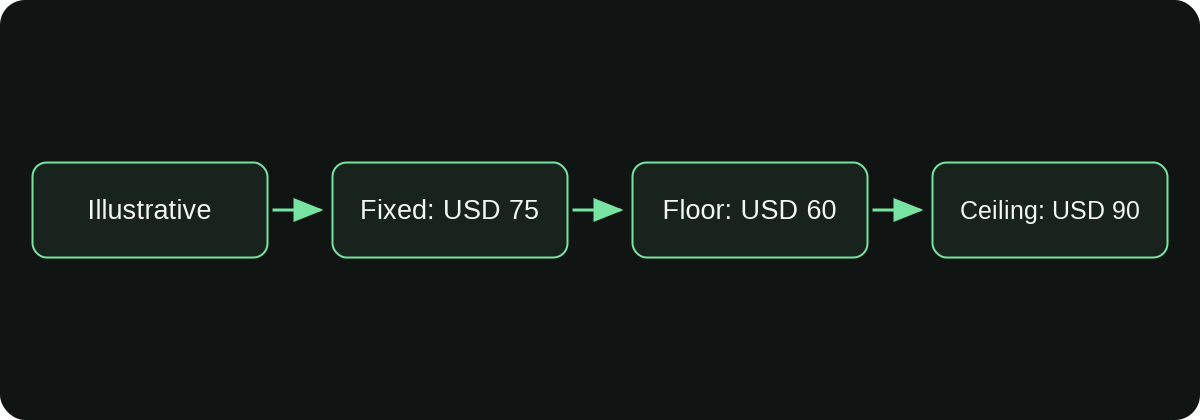
For illustration, suppose a hypothetical producer sells 100,000 pounds at a fixed $75 and another 100,000 at a market-related price with a $60 floor and $90 ceiling. The second quantity’s response differs across market scenarios.
At an assumed benchmark of $50, that simplified second portion uses $60. At $80 it uses $80, and at $110 it uses $90. The fixed portion remains $75 in this deliberately simplified example.
These are invented terms, not Ur-Energy contract details. The example shows why applying the full spot change to every future pound can misstate exposure. Actual agreements can have different references, escalation and conditions.
Then add cost and quantity assumptions. A protected sale price does not guarantee a margin if the cost of obtaining required pounds rises or the company cannot deliver under the agreement.
Price visibility does not remove supply obligations
A contract can require material when internal production is below plan. Inventory, purchased material or another disclosed arrangement may affect how the company meets that requirement.
Evaluate the relevant source and cost. A producer’s own cash-cost metric should not be applied automatically to purchased pounds used for delivery. The resulting economics can differ materially.
The cost-per-pound article separates those definitions. Its lesson for contract analysis is that volume certainty and price visibility are not the same as profit certainty.
Also review counterparty and payment conditions. A signed agreement does not mean cash has already been received. Revenue recognition, delivery acceptance and working capital can create timing differences that matter to the funding plan.
Review the book under both rising and falling markets
In a rising market, committed pricing can provide less immediate upside than uncommitted exposure. But it can also support visibility and planning. Describe the trade-off rather than calling every contract a mistake after prices move.
In a falling market, a floor or fixed price can cushion covered sales while other parts of the business remain exposed. Future contracting, inventory values and development economics can still weaken.
A balanced analysis asks what management knew when contracts were signed and which risks the arrangements were intended to manage. Judging old terms only against a later peak is a hindsight comparison, not a complete commercial assessment.
The price-crash scenarios apply this reasoning to downside. The equity relationship guide explains why the shares need not follow spot uranium mechanically.
Contract-reading questions
Can a customer’s volume option be counted as guaranteed sales?
No. Identify who controls the option and the conditions for exercising it. Base commitments and potential additional quantities should remain separate in a revenue or delivery model.
Does a contract announcement disclose all commercially important terms?
Not necessarily. Public summaries can omit confidential details. Preserve disclosed facts and use scenarios for uncertainty rather than inventing a price, penalty or delivery condition.
Should I compare contract totals across companies without their dates?
No. A larger multi-year total can cover more years or include different flexibility. Align quantities, periods and commitment definitions before treating the headline amount as superior commercial coverage.