
URG Stock provides exposure to one operating company, while a uranium-related ETF holds a portfolio under its particular mandate. The choice depends on whether you want company-specific execution or a broader mix of businesses and assets. An ETF label alone does not establish the exposure you will receive.
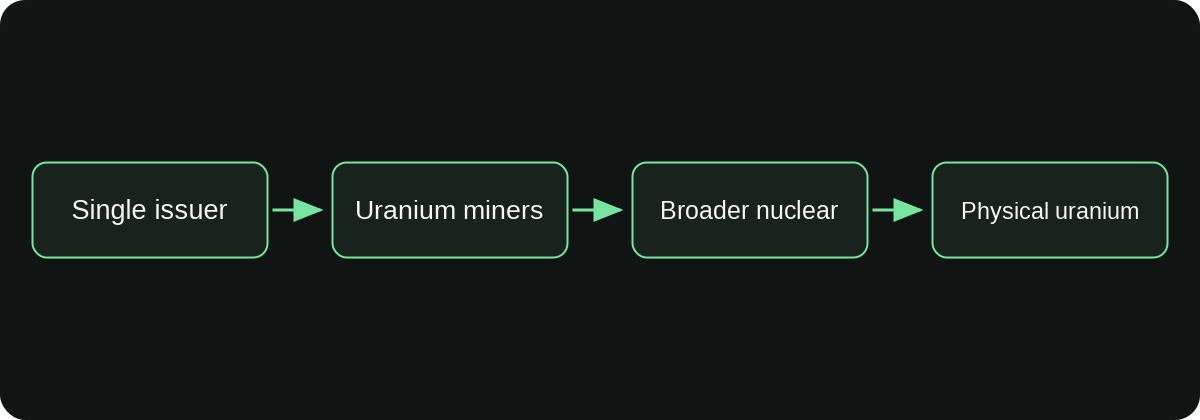
Start by reading the holdings and methodology. A miner fund, a nuclear-industry fund and a physical-uranium vehicle can behave differently even when their marketing uses similar language.
Define the comparison by the intended exposure
Ur-Energy’s company overview describes its uranium-production focus. Buying its shares concentrates the investment in that issuer’s operations, contracts, funding and management decisions.
A fund spreads exposure according to its portfolio rules. That can reduce dependence on a single company while preserving sector risks and introducing fund-specific costs or trading considerations.
Do not assume broader automatically means better for every purpose. Someone deliberately researching a particular operating improvement is asking a different question from someone seeking a diversified nuclear-industry allocation.
The buying-decision article begins with the same purpose distinction. The product should fit the thesis rather than the thesis being invented after selecting a convenient ticker.
Distinguish the main fund types
A uranium-miner fund emphasizes companies involved in mining or related activities under its mandate. The precise mix can include developers or other exposures, so inspect the actual holdings.
A broader nuclear fund can include utilities, equipment or service businesses. VanEck’s NLR fact sheet describes exposure across uranium and nuclear-industry activities, not simply a basket of identical mines.
Sprott’s URNM information and Global X’s URA page provide other mandates to inspect. Read their current documents and dated holdings before assuming they own the same businesses in the same weights.
A physical uranium holding vehicle is another category. Its asset value, expenses and premium or discount can differ from a miner’s operating economics. Do not call every uranium-themed listed product a miner ETF.
Compare the risks that remain concentrated
With URG Stock, an operating interruption, financing change or project outcome can have a direct company-specific effect. There are no other portfolio holdings inside the share to offset that issuer’s performance.
A fund can diversify across companies, but many holdings may share uranium prices, policy exposure or capital-market conditions. Ten miners are not ten independent macroeconomic risks.
Look through the largest weights and geographic or business concentrations. A fund with many names can still depend heavily on a few issuers or the same stage of the fuel cycle.
For your total portfolio, include existing holdings outside the fund. Buying an ETF that already holds a stock you own can increase that company’s effective weight rather than diversify it away.
Calculate overlap instead of counting tickers
Use the fund’s dated holding weight and your investment amount to estimate indirect exposure. Keep the date because rebalancing and price movements can change the weight.
For illustration, a hypothetical $2,000 fund position with a 5% allocation to a company creates about $100 of look-through exposure to that company. Adding a direct $500 position produces about $600 before later movements.
These are invented weights and amounts, not current URG holdings in any named ETF. The calculation demonstrates why a direct stock plus a related fund can overlap materially.
A fund’s number of holdings does not reveal that overlap by itself. Inspect weights and underlying business activities rather than treating the presence of multiple tickers as sufficient diversification evidence.
Include both ongoing and transaction costs
A fund can charge an expense ratio under its documents. Its market trading can also involve bid–ask spread, commissions and currency conversion. A direct stock avoids a fund expense ratio but still has trading and ownership costs.
Do not compare only the advertised commission. For a short holding period, spread and conversion can dominate a small annual fee. For a longer period, recurring costs and the mandate’s implementation become more important.
Read the current expense and holdings documents rather than copying a stale fee from a comparison article. A fund name can remain the same while costs or portfolio details change.
Also inspect the market price relative to reported asset value where relevant. Buying a listed vehicle is a market transaction; its price is not automatically identical to the value of the underlying assets at every moment.
Compare returns on a consistent basis
Use the same dates, currency and return definition. A total-return series including distributions should not be compared with a stock-price chart that omits them without explanation.
Check the history available. A newly launched fund cannot provide an actual investor return before its inception. A backtested index is not the same as a live fund track record.
Avoid declaring a permanent winner from one selected period. A fund’s mix can outperform in one scenario and underperform in another, while a single company’s result can depend on its own execution cycle.
For the underlying company comparison, the peer worksheet helps identify the differences a fund may combine. This prevents a return chart from concealing the economic exposures being compared.
Make a choice with a clear monitoring burden
A direct URG position requires following that issuer’s operations, contracts, financing and valuation. A fund requires monitoring its mandate, holdings, costs and any material methodology changes.
Neither route is maintenance-free or protected against losses. Choose the exposure you understand and can evaluate with the time and information available to you.
If the task is near-term cash preservation, neither a uranium stock nor a sector ETF is automatically appropriate. Market access does not change the purpose of funds needed for an imminent obligation.
ETF comparison questions
Does an ETF holding URG guarantee it will hold the stock indefinitely?
No. Portfolio rules, rebalancing and manager decisions can change holdings. Use current dated disclosures rather than treating a past holding as a permanent commitment.
Can a broad nuclear ETF rise while uranium miners fall?
Yes. Utilities, equipment and other businesses can have different drivers. Inspect the fund’s actual mix before assuming it should track a uranium-price or mining-stock series closely.
Does an ETF distribution prove the underlying miners are profitable?
No. A distribution can reflect the fund’s particular income and tax circumstances. Read its classification and holdings rather than treating the payment as a uniform operating result across constituents.