
URG Stock can be considered only after assessing Ur-Energy’s execution, contracts, funding and valuation against your own purpose and loss capacity. A positive view on nuclear power alone does not establish that the shares are attractive at a particular price.
The useful answer is a decision framework, not a universal buy or sell label. Separate the conditions under which the business could create value from the price and ownership terms at which you participate.
Define the exposure you actually want
Decide whether you want exposure to uranium prices, a particular operating company or the broader nuclear industry. Those are different objectives. A miner adds operating and financing risks that a commodity reference alone does not describe.
Ur-Energy’s company information provides the starting point for understanding its operating focus. Compare that focus with your reason for investing rather than assuming any uranium-related security fulfills the same task.
If the objective is diversified industry participation, inspect a relevant fund’s actual holdings before choosing a single company. If the objective is company-specific execution upside, state why this business rather than a peer is the intended exposure.
The stock-versus-ETF guide helps make that distinction. It does not assume diversification removes market risk or that concentration is automatically inappropriate.
Write an operating thesis with observable conditions
A useful thesis names the operating change needed for value creation. Examples include converting recovery into finished product, sustaining a production rate or meeting deliveries at an acceptable cost. These are questions to investigate, not promises about Ur-Energy’s future.
For each assumption, identify a measurable test and the reporting period when evidence should appear. A broad belief that management will execute is harder to evaluate than a specific expectation about throughput or cost definition.
Distinguish completed events from management targets. A new piece of equipment, an announced study and sustained commercial output are different milestones. Their effects on valuation can differ because the remaining uncertainty differs.
Use the financial filings to compare the thesis with current disclosures. Do not rely exclusively on a promotional presentation if the annual or quarterly report describes material constraints.
Test the funding assumptions
Determine what expenditure the thesis requires and how it is expected to be funded. Separate operating cash generation from financing proceeds and restricted resources. A healthy-looking cash total can conceal funds committed to other purposes.
Examine the timing. A project may eventually improve economics while requiring cash before it contributes revenue. The period between spending and receipts can matter as much as the eventual margin.
Ask how new shares, convertible securities or borrowing would affect your interest. Financing can reduce execution uncertainty while changing value per existing share. Neither effect should be ignored because the industry narrative is favorable.
A practical funding worksheet includes available resources, expected uses, obligations and potential sources. Use ranges where assumptions are uncertain rather than extending one quarter’s spending indefinitely without explanation.
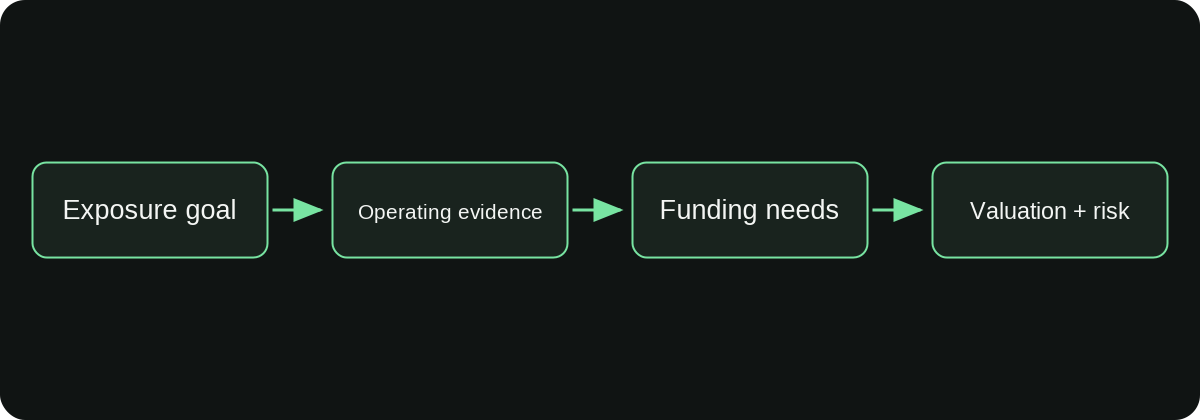
Separate a good business outcome from a good purchase price
A business can improve and still underperform an optimistic valuation. Before buying, ask what the current market price appears to assume about production, costs, uranium prices and financing.
One way to organize the analysis is to model company value under several operating scenarios, then divide the relevant equity value by an appropriate share count. Include potential dilution where the scenario makes it economically relevant.
For illustration, hypothetical equity values of $100 million and $150 million imply different values per share depending on whether the share count is 100 million or 200 million. Do not compare company-value assumptions without the denominator.
These are teaching inputs, not a URG target. A precise output from uncertain assumptions remains uncertain. State what would need to happen rather than presenting a spreadsheet result as an inevitable trading price.
Build a downside case before an upside target
Consider a weaker uranium market, slower operational progress and more expensive funding separately. Then consider whether they could occur together. A downturn can make financing difficult at the same time operating cash generation weakens.
Identify which obligations remain even if growth slows. Fixed operating costs, commercial commitments and regulatory responsibilities can limit the company’s flexibility. Delaying a project may preserve some cash while also postponing future production.
At the portfolio level, decide how much a total loss of the position would affect your plan. For example, a hypothetical $500 position in a $10,000 portfolio represents 5% of the portfolio before subsequent price changes. That calculation is not a recommended allocation.
A stop order does not convert that exposure into a guaranteed smaller loss. Gaps and execution conditions matter. The exit-order guide explains the trade-offs.
Make the decision reviewable
Record the purchase rationale, assumptions, information date and conditions that would lead you to reassess. Separate a business-thesis change from ordinary price volatility. That helps prevent every decline from being reinterpreted as a reason to buy more.
Also define the alternative. Keeping funds available, choosing another instrument or waiting for clearer operating evidence can be legitimate outcomes of research. An analysis need not end in a trade to be useful.
Investor.gov’s investing introduction provides context for relating investments to goals and risk. Your time horizon, diversification and liquidity needs should remain part of the decision.
Before acting, check the actual quote, broker eligibility and costs. A valuation view does not establish an executable price. The buying workflow handles that separate operational step.
Questions before committing money
Does an analyst’s buy rating settle whether URG Stock suits me?
No. A rating reflects a particular analyst’s assumptions, date and framework. It does not know your financial obligations or establish the price at which your order will execute.
Is a large percentage decline evidence that the shares are cheap?
Not by itself. Expectations, funding or business value may have changed. Compare the current price with a current, supported thesis rather than an old high or your own purchase price.
Should I average down automatically after buying?
No automatic rule resolves that decision. Recheck the evidence, total exposure and original assumptions. Adding shares increases the amount committed and should have an independent rationale, not merely reduce an average-cost display.