
A stop-loss or take-profit instruction can organize an exit from URG Stock, but it cannot guarantee the final price or maximum loss. Decide whether price control or execution priority matters most, then check how your broker handles triggers, sessions and partial fills.
An exit level is part of a plan, not a promise from the market. Gaps and changing liquidity can separate the intended action from the actual result.
Start with the position and decision rule
Confirm the quantity held, listing, account and any existing orders. An exit for more shares than you own can create an unintended transaction or be rejected. A second exit order can also conflict with the first.
Write down why the chosen level matters. It may reflect a maximum intended exposure, a chart observation or a reassessment point. Those rationales are different; a round percentage chosen without context does not become meaningful because the interface accepts it.
For URG Stock, company news and uranium-market conditions can change outside the session you are watching. The risk map helps identify events that could make a price move discontinuously rather than smoothly through your level.
Do not calculate position size on the assumption that a stop creates a guaranteed loss ceiling. Consider what a larger gap or inability to exit would mean for your finances.
Distinguish a stop from a stop-limit order
A conventional stop order becomes a market-style instruction after its trigger conditions are met. It seeks an execution at available prices, which can differ materially from the stop price.
A stop-limit combines a trigger with a price limit. It can prevent execution below a specified sale price, but the position may remain unsold if buyers are not available at that level.
FINRA’s stop-order guidance discusses these risks during volatile conditions. Check your broker’s own trigger definition and handling rather than assuming every platform uses identical rules.
The trade-off is unavoidable: an instruction that prioritizes a sale can accept a worse price, while one that rejects worse prices can leave exposure in place. Neither label solves both objectives in every market.
Model a gap instead of only a smooth decline
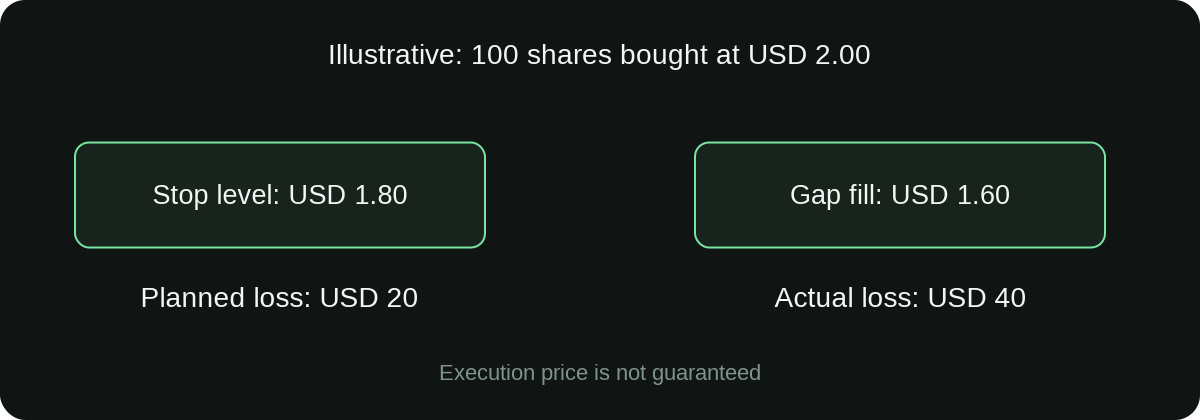
Assume, hypothetically, you buy 100 shares at $2 and set a stop at $1.80. The planned difference is $20 before costs if execution occurs at $1.80. If the first available execution is $1.60, the share-price loss becomes $40.
These numbers are invented and do not describe a current URG quote. They illustrate why a trigger is not an execution guarantee. The market does not have to trade every intermediate price in the quantity you need.
If you instead use a stop-limit with a limit above the available market, the order can remain unfilled. You would still hold the shares and remain exposed to subsequent movements.
Include fees and any financing in the final outcome. A chart-based distance is not the same as the full account result after execution and other charges.
Treat a profit target as an order condition
A sell limit can express a minimum acceptable target price, but reaching a displayed chart level does not always prove your order should have filled. Queue priority, available size, session and the actual trigger data can matter.
A profit target can also create an opportunity cost: selling locks in the execution but ends exposure to later gains on those shares. That is a trade-off, not a malfunction of the order.
For partial exits, specify how many shares the target covers and what should happen to the remainder. A full-position stop left unchanged after a partial sale may no longer match the intended quantity.
The selling workflow explains how to reconcile fills and remaining exposure. Use the broker’s record rather than a chart touch as the evidence of execution.
Check linked-order and cancellation behavior
Some brokers support linked exits, often described as one-cancels-the-other arrangements. Availability and exact behavior depend on the account, security and session. Do not assume two independently entered orders are linked automatically.
Review how partial fills affect the paired instruction and whether cancellation is immediate. A request to cancel may not prevent an execution already in progress. Read the broker’s conditions before relying on a linked setup.
Also inspect expiry. A day order, good-till-cancelled order and conditional instruction can have different lifetimes. Corporate actions or broker policies may change an order’s status or price treatment.
Investor.gov’s online-investing guidance reinforces checking status before submitting replacements. Duplicate instructions can create a larger problem than the original delayed screen.
Verify the session and monitoring plan
A trigger that applies only during regular hours may not respond to an extended-hours move. Conversely, an extended-hours order can face different liquidity and broker restrictions. Verify the actual rule instead of inferring it from the stock’s chart.
Check the NYSE calendar for holidays and shortened sessions. A conditional order entered on a closed market does not necessarily become an immediate exit.
Keep enough attention on the account to notice rejected, expired or partly filled instructions. An automated order reduces some manual work but does not eliminate the need to understand whether it remains active.
After execution, compare intended trigger, actual fills, charges and remaining quantity. That review can improve the next plan without pretending a single successful trade proves a strategy reliably works.
Exit-order questions
Does a trailing stop guarantee that a gain cannot become a loss?
No. The trigger can adjust under the broker’s rules, but gaps and execution conditions still apply. Understand the reference price and trailing amount before treating it as a guaranteed profit lock.
Can an alert replace a stop order?
An alert only notifies you under its conditions. It does not itself sell shares. Device availability, response time and the later market can affect what happens after the message arrives.
Should the stop always sit below a moving average?
There is no universal rule. The average’s settings, volatility, investment horizon and reason for holding matter. A technical level is an observation to interpret, not a guaranteed boundary for future prices.