
To sell URG Stock, confirm the quantity you own and can sell, review existing orders, submit the intended sell instruction and verify the fills. Closing the equity position and withdrawing the proceeds are separate stages because settlement and broker conditions still apply.
A position shown on screen can include unavailable shares, pending activity or account-specific restrictions. Begin with the account record rather than assuming every displayed share is immediately available for a new order.
Establish the position you intend to close
Check the account, issuer, listing, quantity and currency. Ur-Energy’s URG listing page helps distinguish the US route from URE on the TSX. Use the position actually held in your account.
Review pending transfers, restrictions and any open sell instructions. Shares already committed to another order may not be available for an additional sale. If you replace an order, confirm its final cancellation status first.
Also determine whether you want a complete exit or a partial reduction. Write the intended remaining quantity before entering the order. That makes it easier to spot an accidental oversell or a mistaken fractional balance.
If borrowing or another arrangement affects the position, inspect the broker’s terms. Selling stock can change a margin balance or account exposure in ways that are separate from the quoted share proceeds.
Select the tax lot deliberately when relevant
Your broker may allow selection among acquisition lots, subject to its procedures and applicable rules. Review the quantity, basis and dates associated with the proposed sale rather than discovering the default choice after execution.
Tax analysis is not limited to comparing a sale price with one displayed average cost. Account type, adjustments and the company’s foreign-issuer considerations can matter. The US tax guide addresses those questions separately.
Keep records supporting the method used and verify any selection deadline with the broker. Do not assume an interface estimate determines the final tax outcome or replaces your responsibility to maintain adequate records.
A decision to sell should still follow the investment purpose and current circumstances. Avoid allowing an estimated tax figure alone to override a necessary review of business risk or required liquidity.
Choose the sale instruction and session
A market order seeks execution at available prices; a limit specifies a minimum acceptable sale price but may not execute. Price certainty and execution certainty are different objectives.
Investor.gov’s order-type explanation provides the basic distinctions. Check your broker’s support for the specific session and share type rather than assuming every instruction operates in extended hours.
Inspect bid, ask, quoted size and timestamp. A recent last trade does not establish that a buyer will take your whole position at that price. Thin liquidity can create multiple fills with different prices.
For illustration, selling 300 hypothetical shares in two equal fills at $1.20 and $1.18 produces $357 gross, or $1.19 per share on average. These are invented prices, not a URG trading record.
Confirm what actually filled
After submission, inspect the execution status. Accepted, open, partly filled, filled and cancelled mean different things. An open order does not remove the stock’s price exposure merely because you intend to exit.
If the order partially fills, record the sold and remaining quantities. Decide whether to retain, amend or cancel the remainder according to your objective and market conditions. Check the broker’s treatment of a changed order.
A cancellation request is not always instantaneous. Avoid sending a replacement for the full original quantity until you know whether additional fills occurred. Otherwise, the combined orders can exceed the position you meant to sell.
The online-investing guidance reinforces the need to verify status rather than infer failure from a slow screen. Preserve the broker’s trade confirmation as the execution record.
Separate trade proceeds from settled and withdrawable cash
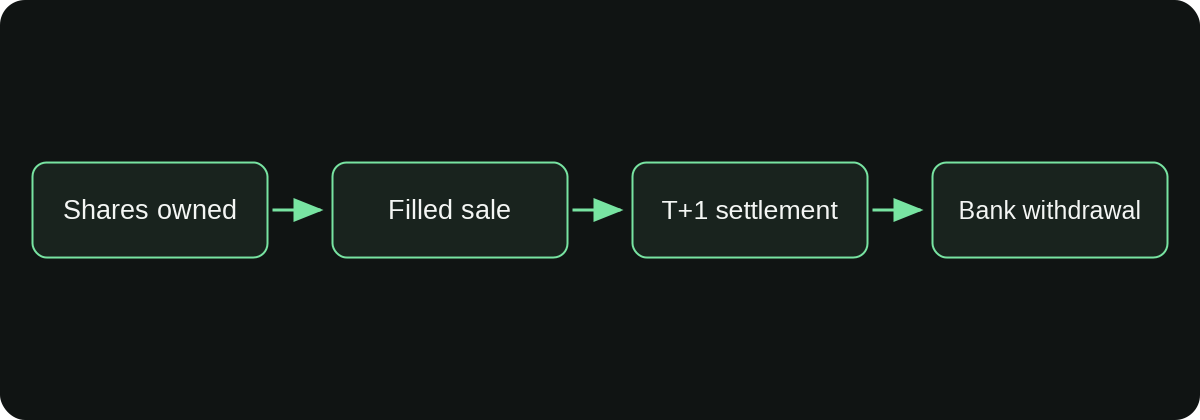
US stock transactions generally follow the T+1 settlement cycle. Business-day settlement is different from a fixed number of hours after clicking sell.
Holidays and account conditions can affect availability. A broker may show buying power before allowing a bank withdrawal. A sale can also first reduce an existing debit balance rather than create the cash amount you expected to withdraw.
Check the settlement date on the confirmation and the broker’s available-to-withdraw field. If you need a specific currency, include conversion and transfer costs. Gross share proceeds are not necessarily the final amount arriving in your bank.
For a required payment, plan around dependable availability rather than the most optimistic timeline. Verify bank details and expected processing before initiating a transfer out of the account.
Reconcile the completed exit
Confirm that the intended share quantity is zero or at the planned reduced level. Check for leftover fractional shares, open orders and related account instructions. A zero dollar estimate is not always the same as a closed position.
Save the sale confirmation, lot records, charges, currency conversion and withdrawal reference if applicable. Those documents connect the investment transaction with the eventual cash movement.
Then review why you exited. A thesis change, portfolio adjustment and required spending are different decisions. Recording the reason can help you evaluate the process later without treating subsequent price movement as the only measure of judgment.
If your exit was triggered by a stop, compare intended and actual execution. The stop-order article explains why a trigger can differ from the final fill. Use the difference to understand execution risk rather than assuming the order malfunctioned.
Selling questions
Can I sell shares held through another broker without transferring them?
Do not assume so. The selling account must have the appropriate position or another authorized arrangement. Confirm transfer completion and availability before entering an order that could otherwise be treated as a different transaction.
Does closing a position close the brokerage account too?
No. The account remains a separate relationship with its own statements, residual balances and obligations. Download records and resolve pending activity before considering an account closure.
What if the market moves sharply after my sale?
That does not change the completed execution or prove the decision was wrong. Assess whether the sale followed your stated purpose and evidence. A later movement should not replace a review of the information available when you acted.