
In situ recovery, or ISR, recovers uranium by circulating a suitable solution through mineralized ground and bringing dissolved uranium to the surface. For URG Stock, understanding the process helps explain why geology, water movement, processing and restoration all affect operating outcomes.
ISR is different from excavating ore in an open pit or underground mine. That difference does not make it universally suitable, impact-free or automatically profitable.
Begin with a suitable geological setting
The process needs mineralization and ground conditions that allow the intended movement and management of solution. The presence of uranium alone does not establish that ISR will work as assumed.
Permeability, continuity and the relationship between the ore zone and surrounding formations are relevant technical questions. A project assessment must connect those conditions with the proposed wellfield design and recovery method.
For investors, this means a grade or resource headline cannot answer every operating question. A deposit can contain uranium while requiring further evidence about how much can be recovered, at what rate and under what conditions.
The drilling-update guide explains why geological observations and hydrogeological studies provide different information. Both can matter before an operating plan is established.
Follow injection, production and monitoring functions
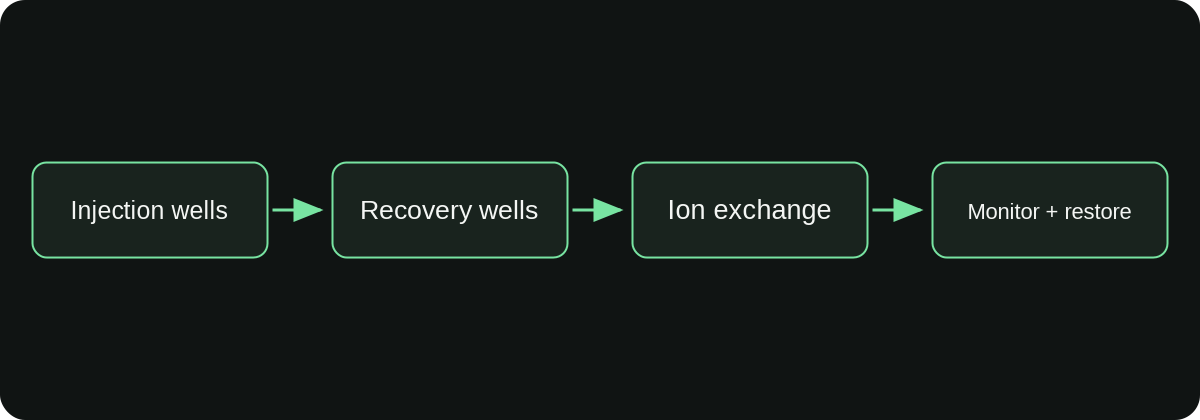
Ur-Energy’s ISR explanation describes using native groundwater supplemented with oxygen and baking soda, recovering uranium-bearing solution through production wells and separating uranium by ion exchange.
The EPA’s Class III well overview distinguishes injection, extraction and monitoring functions in solution mining. Those functions support both recovery and control of the process.
The system is not simply a one-way pipe from ground to product. Solution movement, chemistry and operating balance must be managed. A wellfield that does not behave as modeled can affect recovery and the amount reaching surface processing.
Avoid interpreting the method as permission to ignore groundwater. Water conditions and monitoring are central to the process, not an optional environmental add-on after uranium is produced.
Capture is followed by additional processing
Ion exchange captures uranium from the recovered solution. Further treatment prepares saleable uranium concentrate. The company can therefore report material at different stages before it becomes finished product.
A captured pound, a drummed pound and a delivered pound are not interchangeable observations. Timing and processing capacity can create differences between them even when the underlying reporting is consistent.
Ur-Energy’s Shirley Basin description provides an operational example: uranium-loaded resin can travel from a satellite operation to the Lost Creek hub for processing. That creates logistics and shared-capacity questions.
For shareholders, the relevant test is whether the whole chain converts recovery into finished material and commercial deliveries as expected. Improving one stage does not prove the remaining stages have no constraints.
Recovery rate and cost depend on actual performance
A project model can assume a recovery percentage, flow rate and operating cost. Those assumptions need to be tested against field and plant performance. They are not guaranteed merely because the project uses a known mining method.
Changing solution concentration or throughput can alter the amount recovered over time. Supporting systems, maintenance and water handling can affect how consistently the process operates.
A simple teaching relationship is recovered material equals the relevant material available multiplied by an assumed recovery fraction, subject to the model’s definitions. Increasing the assumed fraction changes the output, but arithmetic alone does not establish the fraction is achievable.
Do not compare two ISR projects only by a reported cost-per-pound headline. Their stages, operating conditions, inventory accounting and included costs may differ. The cost guide explains that separate accounting task.
Restoration and closure remain part of the project
The NRC’s groundwater information identifies groundwater restoration as part of licensed uranium ISR activities. Recovery is not the only obligation that determines the project’s economic life.
Investors should examine monitoring, restoration, closure and financial assurance in the relevant project documents. Money pledged for a regulatory purpose may not be freely available for ordinary operations.
Those obligations can persist after a particular wellfield stops producing. A valuation that counts expected uranium receipts but omits the costs and timing of required work can overstate value.
Do not assume that national support for uranium production removes site-specific duties. The permitting article distinguishes operating permissions from ongoing compliance and future expansion approvals.
Compare ISR with conventional mining carefully
ISR can avoid some excavation and ore-handling activities associated with conventional methods. That can change the capital and operating structure, but it does not create a universal cost ranking across every deposit.
Conventional and ISR projects have different technical requirements and constraints. A method suited to one geological setting may be unsuitable elsewhere. A comparison needs the actual project, not just the mining label.
Likewise, environmental impact should be assessed by the relevant pathways and controls. Less visible surface excavation does not establish that water management or restoration has no importance.
For a business comparison, evaluate development stage, technical assumptions, capital requirements and observed performance together. A broad claim that one method is always cheaper or safer would conceal the conditions that determine the result.
Use the process to interpret company reports
Track wellfield development, captured material, finished output, inventory and deliveries separately. Add water-system and restoration milestones where relevant. This makes operating updates easier to connect with financial results.
When management announces a process improvement, identify which step it targets and which later measurement should demonstrate success. An equipment purchase and sustained operating benefit are different observations.
The Lost Creek overview applies this process to the hub relationship. Understanding the physical chain gives a URG Stock investor a better basis for evaluating news than treating ISR as a generic low-cost slogan.
ISR questions
Does ISR recover every pound in a resource estimate?
No. A resource estimate and an assumed or observed recovery fraction are different parts of the analysis. Project economics must account for what can actually be recovered under the proposed conditions.
Can an ISR operation expand by adding wells alone?
Not necessarily. Feed, processing, water handling, approvals and infrastructure can constrain expansion. Assess the complete system rather than treating well count as an automatic production multiplier.
Does groundwater restoration happen only after the whole company stops operating?
No. Duties can relate to individual areas and stages under their applicable requirements. Review the project-specific plan and schedule rather than assuming all restoration is deferred to one distant final date.