
Permitting risk for URG Stock depends on the project, activity and approval stage. A licensed operating facility does not mean every expansion, new wellfield or proposed satellite is already authorized. Identify the permission required and the conditions that remain.
For Wyoming uranium projects, understanding the responsible authorities is as important as reading a company milestone. Broad support for domestic nuclear energy does not replace site-specific review or continuing compliance.
Identify the regulator for the actual activity
The NRC’s uranium-recovery facility information explains that Wyoming is an Agreement State for relevant uranium recovery regulation. The NRC does not directly regulate every active recovery operation in such states.
The Wyoming Agreement State page provides the regulatory context. Use the authority and record relevant to the project rather than assuming every authorization comes from the same federal office.
Other activities can involve additional requirements. Land use, injection, water management and environmental obligations should be identified by their actual scope. One approval letter may not settle all of them.
A useful project file names the activity, authority, document and permitted boundary. That is more precise than labeling a project fully permitted without explaining what work the statement covers.
Separate an application from an approval
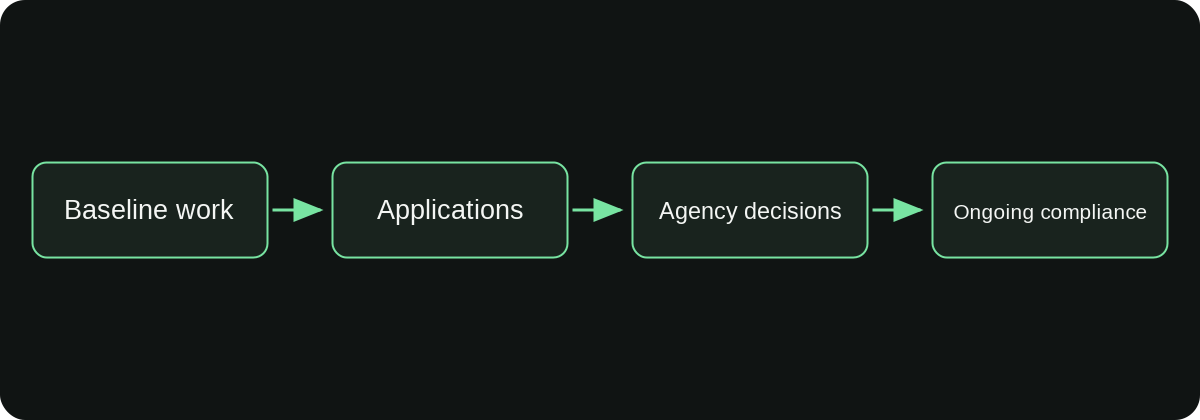
Baseline studies gather information; an application requests authorization; a review evaluates the request; an approval permits specified activity under conditions. Construction and operating performance are later or separate observations.
Ur-Energy’s November 17 Lost Soldier release describes baseline fieldwork and a planned technical report. It should not be rewritten as a completed permit or a producing mine.
For an operating project, distinguish the existing authorized activity from a proposed change. A new area, process or supporting facility may require additional review even if the original operation is licensed.
Record the exact stage in a watchlist. If an announcement says a package was submitted, the next evidence is the authority’s response, not an assumed completion date invented from another project’s timetable.
Map water and injection requirements separately
ISR involves moving solution through the ore zone and recovering it for treatment. The relevant water and injection permissions are therefore central to the operating model.
The EPA’s Class III well overview describes permits and applicable aquifer-related requirements for solution mining. Read the actual program and jurisdictional conditions rather than assuming all wells are authorized by a general mining licence.
For investors, water-system constraints can affect both timing and expenditure. Supporting equipment may require construction, commissioning and permitted operation before it delivers the assumed benefit.
The ISR guide explains why recovery and water management are linked. A favorable uranium price does not remove the technical or regulatory work needed to operate that system.
Evaluate the conditions attached to an approval
An authorization can define location, capacity, monitoring, reporting and operating conditions. Its existence is important, but the conditions determine what the company can actually do.
Check effective dates, amendments and any relevant limits. A permit for one area should not be applied to a neighboring target merely because the same company controls both properties.
Also distinguish design or licensed capacity from demonstrated performance. Permission to operate at a boundary is not evidence that the facility has reached it. The Lost Creek article addresses that operational distinction.
Do not allege a violation from a production shortfall or a delay without evidence. Regulatory compliance, technical performance and commercial results are separate questions even when they affect each other.
Include restoration and financial assurance
Operating and closure responsibilities can require monitoring, restoration and security for future work. A project’s economics should include those obligations rather than treating them as unrelated after the uranium is sold.
Financial assurance can restrict the use of some resources. A balance classified as restricted should not automatically be counted as cash available for corporate expansion or distributions.
Review the company’s relevant notes and project documents to understand the purpose and scope. The amount required can change as plans, estimates or requirements change, so preserve the observation date.
The earnings-reading guide separates restricted funds from ordinary liquidity. That distinction connects environmental obligations with the funding analysis shareholders need.
Translate a delay into business consequences
A permitting delay can postpone spending, production or a commercial decision. Its effect depends on which other activities can continue and what obligations remain due in the meantime.
For illustration, a hypothetical six-month delay might conserve some construction expenditure while deferring expected receipts. It could also require additional study costs or change a funding plan. Those effects need project-specific assumptions, not a universal penalty percentage.
Compare the revised schedule with delivery needs, available inventory and financing. A delay at a proposed expansion differs from an interruption at an operating processing hub.
The risk map helps identify shared dependencies. A regulatory issue can become a cash or commercial issue through timing without changing the amount of uranium estimated in the ground.
Maintain an approval register instead of a binary label
Use columns for project, activity, authority, status, source date, conditions and next expected action. Keep company announcements beside the relevant public record where accessible.
If a record cannot be located, identify the gap and seek clarification. Do not substitute an old presentation for a current amendment or assume a missing online document proves noncompliance.
Update the register when an authority issues a decision or the company changes the plan. Preserve the previous stage so readers can distinguish actual progress from a reworded description of the same pending work.
This method makes permitting analysis specific and reviewable. It is more useful than either declaring every project de-risked or treating every remaining approval as evidence it cannot proceed.
Permitting questions
Does an operating licence guarantee approval of the next mine unit?
No. Determine what the existing authorization covers and whether the proposed activity needs another approval or amendment. The answer depends on the actual project documents.
Can a technical report substitute for an environmental authorization?
No. It addresses a different task. Geological and economic assessment can support a development decision without granting permission to perform every proposed activity.
Should a national policy statement be entered as a project permit?
No. Record the policy separately and trace any implementation effect. A broad objective does not identify the site, conditions or authorized activity required for a project-specific permission.