
Track URG Stock drilling updates by recording the project, program objective, completed work and evidence stage. A drill-hole count is not a resource estimate, and a resource estimate is not finished uranium inventory. The useful task is following how evidence develops toward a decision.
Different programs can test exploration potential, define an existing area or support an operating wellfield. Comparing them solely by the number of holes can misrepresent what management is trying to accomplish.
Identify the project and purpose
Start with the location and its relationship to existing operations. An adjacent target, a separate development property and production-area drilling can have different infrastructure and approval requirements.
Then identify the stated question. Is the program looking for mineralization, checking continuity, gathering hydrogeological information or installing operating wells? Those are different tasks and should not be grouped into a single exploration-success measure.
Ur-Energy’s Q3 release described an October 2026 exploration program at Lost Creek South targeting 120 holes. That announced scope should not be reported as 120 completed successful holes without a later update.
Check the units used for drilling footage and depth, especially when comparing programs described in feet and meters. A larger hole count can still represent less total footage or a different sampling objective. Record both the quantity of work and its purpose before interpreting an apparent acceleration. Depth and spatial coverage also affect what the program can establish.
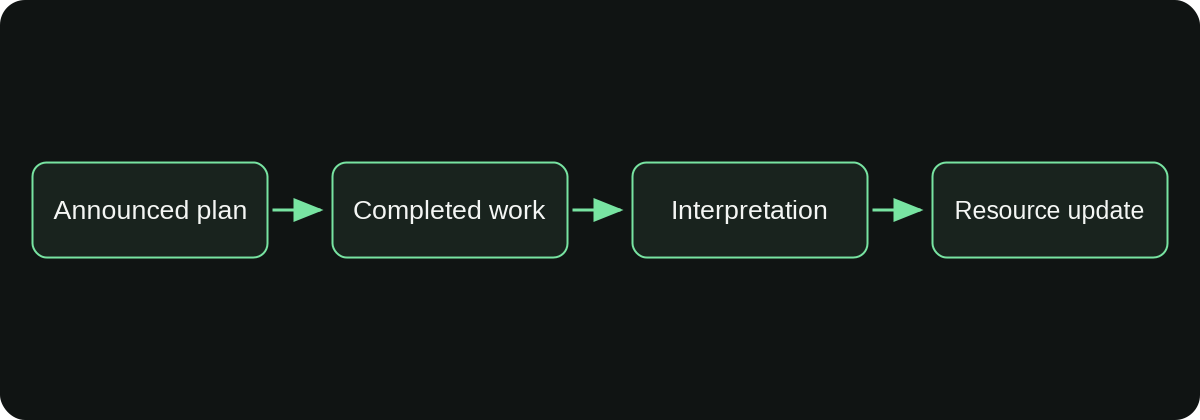
Maintain planned, completed and interpreted work in separate fields. A program can progress operationally before its technical conclusions are ready for disclosure.
Build an evidence ladder
Use a sequence that distinguishes field activity from conclusions: drilling completed, data validated, geological interpretation, resource reporting, economic assessment and development decision. Not every program reaches every stage.
A positive observation in an individual hole can be relevant without establishing the size or continuity of a deposit. A larger set of observations can improve interpretation while still leaving recovery and economic questions unresolved.
The company’s technical-report archive provides the formal documents needed for resource and assessment work. Check the effective date and project boundary before assuming a new headline updates every resource number.
When an update stops at an earlier stage, state that stage accurately. Avoid filling missing conclusions with a projected resource based on a few encouraging observations.
Distinguish geological data from ISR operating conditions
For an ISR project, uranium occurrence is only part of the technical question. The ability to move solution through suitable ground and manage recovery matters to the proposed process.
Hydrogeological studies and testing therefore answer questions that a simple grade headline does not. They can affect wellfield design, recovery assumptions and the data required for permitting.
Ur-Energy’s November 17 Lost Soldier update describes baseline fieldwork and a planned technical report. Treat those as development evidence, not proof that a mine is fully authorized or commercially operating.
The ISR guide explains the process. It helps investors understand why impressive mineralization alone cannot establish a reliable production rate or acceptable operating cost.
Read resource changes with their assumptions
When a technical report is published, record resource categories, cutoff assumptions, estimation method, area covered and effective date. Compare those definitions with the previous report before interpreting a numerical increase.
A change can reflect new drilling, revised geological modeling, changed economic assumptions or a different reporting boundary. More reported pounds do not necessarily come entirely from new discoveries.
Keep measured, indicated and inferred categories separate. A change in confidence classification is meaningful even when the total changes little. Conversely, adding lower-confidence material does not make all pounds equally certain.
The resources-versus-reserves guide explains the valuation implications. Avoid multiplying every newly reported pound by a current uranium price and calling the result shareholder value.
Track the work against management’s stated timetable
Create a dated log with announcement, intended work, target completion, next document and actual follow-up. Preserve revisions. A later date can matter to funding or project sequencing even when the geological thesis remains possible.
If a release says a decision will follow a report, record both milestones. Publishing the document does not automatically mean construction has been approved. A positive decision also does not prove all external authorizations are in place.
Use the news archive and formal filings to follow developments. Repeated media summaries of the same release should remain one underlying event in the log.
For an overdue milestone, check whether a document appeared in the filing or technical archive before assuming cancellation. Describe unresolved status precisely rather than inventing either success or failure.
Connect the result to a business implication
Ask what the new evidence changes: potential feed for existing infrastructure, project timing, required expenditure or uncertainty about recovery. A technical result can be important without immediately changing reported revenue.
For a satellite concept, evaluate the processing and logistics assumptions. For a stand-alone development, examine the infrastructure and funding required. Those models can produce very different economics from similar resource headlines.
A useful analysis ends with the next test. If the thesis depends on continuity, await the relevant interpretation. If it depends on recoverability, inspect the supporting work. If it depends on permitted development, follow the actual approval sequence.
The Lost Creek hub article and permitting article connect the geological evidence to operational and regulatory questions without collapsing them into one milestone.
Drilling-update questions
Can historical drill holes be added directly to a new resource total?
No. Historical information needs appropriate validation and interpretation within the reporting framework. A hole count describes data availability, not a measured number of economically recoverable pounds.
Does a larger drilling budget prove management expects a discovery?
It indicates planned expenditure and investigation, not a guaranteed result. Read the program objectives, financing and decision criteria rather than treating spending as evidence of the outcome being sought.
Should every encouraging result change a stock target immediately?
Not automatically. Determine whether it changes a material model assumption and by how much. Early evidence can reduce uncertainty without supporting a precise new production schedule or per-share value.