
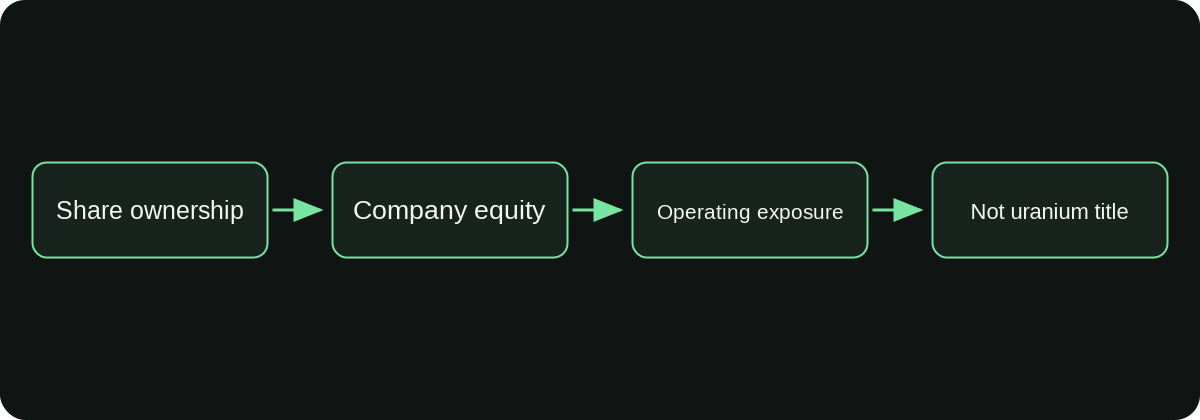
URG Stock represents an ownership interest in Ur-Energy, a uranium mining company. It is not a direct holding of uranium, a nuclear utility or a fund tracking the uranium price. Shareholders depend on the company converting its assets and operations into value after costs and financing obligations.
The first useful question is therefore what the business does with uranium, rather than whether nuclear power is attracting attention. A promising industry does not make every company equally profitable or every purchase price reasonable.
Identify the company and the security
Ur-Energy’s investor information identifies URG on NYSE American and URE on the Toronto Stock Exchange. Verify the company name, listing venue and currency in your broker before entering an order.
A share gives you an economic interest in the company under the relevant corporate and security terms. It does not give you personal title to a particular pound of uranium in a warehouse. Investor.gov’s stock explanation describes the basic ownership distinction.
That difference matters if the commodity rises while the company faces operating problems. A shareholder can lose money even when uranium becomes more valuable, because equity reflects costs, funding, execution and the price already paid for expected success.
Do not use the number of dollars per share as a shortcut for company size. Market capitalization depends on the share count as well as price. A low nominal quote does not establish that a business is cheap.
Understand the operating exposure you are buying
Ur-Energy’s company overview describes its Wyoming in situ recovery operations, including Lost Creek and Shirley Basin. Those assets create exposure to uranium production rather than electricity generation.
A miner must recover material, process it into saleable product and meet delivery conditions. Each stage can require equipment, labor, working capital and regulatory compliance. Owning a company positioned in the fuel cycle does not mean owning every part of that cycle.
Conversion, enrichment and fuel fabrication are separate activities from producing uranium concentrate. News about a new reactor or enrichment facility may matter to long-term demand, but it does not automatically produce an immediate purchase order for Ur-Energy.
The business-model guide follows that physical and financial sequence. For a beginner, recognizing where the company sits is more useful than treating all nuclear-related equities as substitutes.
Separate the commodity thesis from the company thesis
A commodity thesis concerns uranium supply, demand, inventories and prices. A company thesis concerns how Ur-Energy could benefit under its actual operating and commercial arrangements. You need both before evaluating the shares.
Suppose, hypothetically, uranium prices rise while a producer’s finished output falls. Revenue may not improve as expected if the company cannot deliver the required material. Conversely, contracted deliveries can make a quarter’s realized price differ from a spot indicator.
Write each assumption separately. “Demand may grow” should not silently become “all future production will sell at today’s spot price.” “A project has resources” should not become “those pounds are already finished inventory.”
This separation makes the thesis testable. You can compare later production, costs and contracts with the assumptions that motivated your interest, instead of explaining every price move with the same industry narrative.
Read the equity claim after funding needs
The company may need cash for wellfields, processing, exploration, restoration and ordinary operations. Shareholders participate in the residual business value after its obligations. That makes the funding plan relevant even when projects appear attractive.
A financing can improve the company’s ability to execute while changing the number or seniority of claims on future value. Examine share issuance, convertible securities and debt on their actual terms rather than labeling all financing either good or bad.
For illustration, increasing a company’s hypothetical value from $100 million to $120 million does not increase value per share if its shares rise from 100 million to 150 million. The corresponding values are $1 and $0.80 per share. These are teaching assumptions, not Ur-Energy figures.
The example explains why project progress and shareholder returns are related but different outcomes. A larger business can still leave each existing share with a smaller interest than an optimistic headline implies.
Build a first research file
Use the SEC filings directory to locate the annual report, latest quarterly report and material updates. Record the reporting period and filing date separately. They identify different points in time.
Read the business description, liquidity discussion, risk factors and relevant notes before focusing on earnings per share. Mining accounts also require attention to inventory and physical production measures, which can move differently from reported revenue.
Keep a short worksheet with four columns: claim, supporting evidence, uncertainty and next event to check. A useful entry might concern production conversion or a delivery obligation. Avoid copying analyst targets without understanding their dates and assumptions.
For dated company developments, consult the news guide. It distinguishes reported events from future milestones instead of treating every announcement as completed economic value.
Decide whether the exposure fits your purpose
URG Stock may interest someone specifically researching uranium-mining exposure. That does not establish suitability for an income requirement, emergency reserve or investor unable to tolerate company-specific losses.
Compare a single company with a fund only after inspecting what the fund holds. A nuclear-industry ETF can include utilities or equipment businesses whose economics differ from mining. Diversification changes the exposure rather than guaranteeing a better return.
Before buying, identify the maximum financial loss you could tolerate and the evidence that would challenge your thesis. A plan to reassess operating facts is more useful than assuming a falling quote must represent a bargain.
Beginner questions
Is URG Stock the same as a uranium futures contract?
No. Equity and futures create different claims, pricing dynamics and obligations. A share does not have a commodity contract’s delivery terms merely because the company produces uranium.
Can I buy a fraction of a URG share?
That depends on your broker’s eligible-security and account policies. Check the actual order interface and ownership terms rather than assuming every US-listed security supports fractional trading everywhere.
Does owning shares let me direct mine operations?
Ordinary shareholders may have voting rights under the applicable terms, but they do not personally manage daily operations. Distinguish shareholder participation from the responsibilities of directors and management.